
From prototyping to industrial fleet management – the technology securing your supply chain against future demands
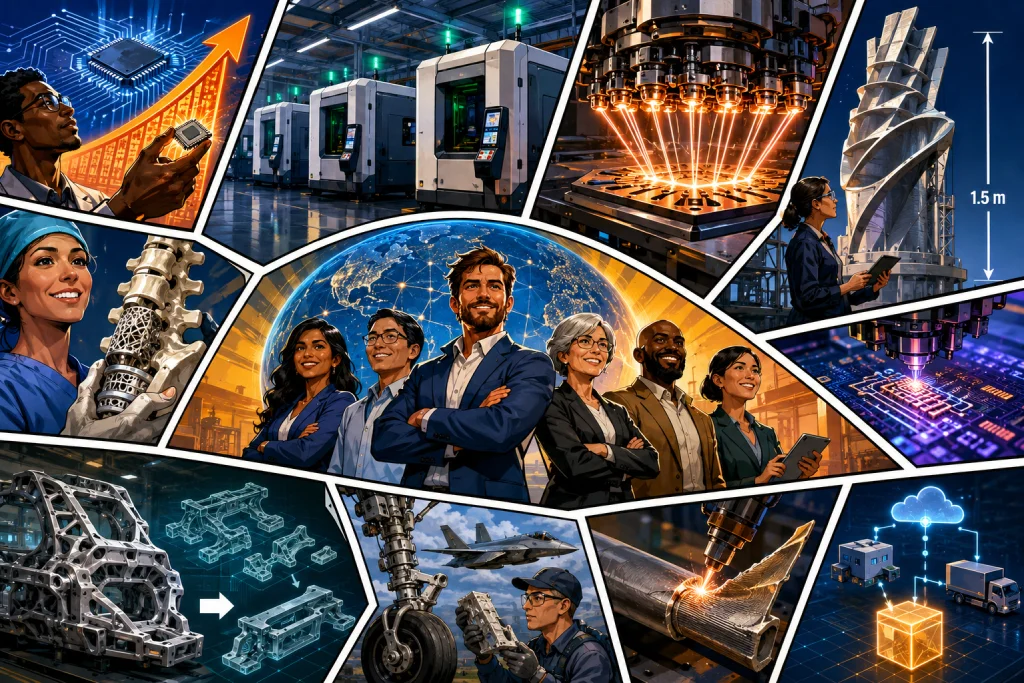
Gordon Moore predicted in 1965 that the computing power of microchips would grow exponentially. This development formed the basis for the entire modern electronics industry. We are now observing exactly the same maturation curve for industrial 3D print. The technology has left the early “prototyping phase” that characterized the 1980s and has entered a new industrial era defined by standardization, high volume, and repeatability.
Just as the semiconductor industry had to transform from manual processes to fully automated factories to keep up with demand, additive manufacturing is now undergoing the same evolution. Industry experts point out that the key to this scaling lies in the shift from standalone machines to advanced fleet management. The central question in the industry is no longer whether the technology works, but whether it can deliver the same flawless quality in series of 10,000 units. This is where companies move from the development department to real production.
What do microchips and 3D print have in common?
The parallel to microchips is not accidental. The semiconductor industry has spent decades perfecting processes to print nanometer-sized structures with extreme precision. This knowledge of process control and material science is now being transferred directly to 3D print. Where 3D print was previously seen as an isolated process for models, we now see an integration into the production line that resembles the high-tech facilities of chip production. It is about data collection and a “Zero-Fail” mentality that makes it possible to view 3D print as a manufacturing method just as predictable as CNC machining or injection molding.
How do we ensure “Zero-Fail” in scalable production?
Reliability is the most important parameter for decision-makers and production managers. In industries where errors cost large sums in downtime or safety risks, “good enough” is not an option. Market data emphasizes that the technology is mature: the largest industrial metal systems are running in the field globally today, and the vast majority of these operate in fleets rather than as standalone units. This proves that the industry uses them for continuous series production and not just for tests.
We see this “Zero-Fail” mentality playing out concretely in the medical industry. Surgeons today use spinal implants in titanium that are 3D printed with a special lattice structure. This structure mimics the internal structure of the bone and promotes healing, which requires biocompatibility and extreme precision. If the technology can pass the strict requirements for an implant in the human spine or a metal hinge in an aircraft engine that significantly reduces weight in an extremely hot environment, it can also handle critical industrial production. At 3D actions, we validate materials and processes specifically to guarantee this predictability for your company.
What do 12 lasers and 1.5 meters of build height mean for your production?
Scaling requires raw machine power and speed. We have seen a significant technological leap with the introduction of systems that use up to 12 lasers of 1 kilowatt each simultaneously. This drastically increases print speed and makes it possible to compete directly with traditional casting on the price per part when including the elimination of tooling costs.
At the same time, build volume is no longer a limitation for large parts. With a Z-axis of up to 1.5 meters, the industry can now print large, continuous components in metal without joints. Looking toward polymers, large-scale technology (Big Area Additive Manufacturing) is already printing molds for wind turbine blades and entire chassis. This means that engineers can rethink designs that previously required assembly and welding of many small parts into a single, strong part. This reduces weak points and simplifies assembly.
Can you print electronics and sensors at the micron level?
3D print is not just taking over mechanical parts. Recent breakthroughs from the research world show that we can now print active electronic components with a resolution as low as 20 nanometers. This enables an advanced “Chiplet” approach, where small, specialized chips are placed on a printed base.
A concrete example of this precision is seen in the production of components for consumer electronics. In a case with a global manufacturer, they succeeded in printing conductive silver traces with a width of only 2 microns for a touchscreen. The result showed a minimal light loss of only 4% compared to standard film. The technology allows printing of conductors, insulators, and semiconductors in the same process directly at the facility. This moves the production of electronics from giant, central factories to local, flexible solutions where “smart parts” can be printed on-demand.
Why are billions being invested in the technology?
When established players in the photonics and manufacturing industry commit amounts equivalent to over 48 billion INR to acquire 3D print manufacturers, it sends a clear signal to the market. This is not high-risk venture capital; it is industrial strategic consolidation. These acquisitions are often driven by companies with over 100 years of experience in precision optics and semiconductors.
These massive investments remove much of the risk for manufacturing companies considering implementing the technology. It shows that 3D print is ready for “heavy industry” and is no longer a niche. Production is strategically placed in Western countries to secure the supply chain for the defense and aerospace industries. For our partners, this means investing in a technology that the world’s leading industrial conglomerates are betting their future on.
How do you transform inventory with digital manufacturing?
Moore’s law was about making things smaller and faster. In modern manufacturing, it is about making inventory digital. By moving from physical storage to digital files, you remove large capital ties and the risk of obsolescence. A strong example from the defense industry shows that approximately 5,75,000 INR could be saved by 3D printing a single component for a landing gear instead of replacing the entire module. This demonstrates the value of decentralized production, where the spare part is produced exactly where the need arises.
Innovative car production demonstrates the same principle. Examples have shown a reduction in the number of components from 2,000 to under 60 by consistently designing for 3D print. For your company, this means fewer part numbers to manage, less storage space, and the opportunity to repair rather than replace. With technologies like DED (Directed Energy Deposition), we can even repair worn, expensive parts like turbine blades by printing new material directly onto the damaged area. It is not just a new production method; it is a fundamental optimization of your business model.
FAQ: Industrial 3D print and scaling
Here you will find answers to the most important questions regarding the maturity of 3D print technology and how it can be strategically implemented in modern production companies.
Are 3D printed parts strong enough for industrial use?
Yes, industrial 3D print delivers parts with the same or better strength than conventional methods. The technology is used today for critical components such as spinal implants in titanium and aircraft engine parts. Through validated processes, full biocompatibility and heat resistance are achieved, guaranteeing durability in even the most extreme environments and under high loads.
When can 3D print compete economically with casting?
3D print now competes on the price per part for both small and medium-sized series, as expensive molds are eliminated. By using machines with up to 12 lasers, costs are significantly reduced. This makes the technology economically attractive for everything from complex geometries to on-demand production, while avoiding large capital ties in inventory.
What are the advantages of a digital inventory?
A digital inventory significantly reduces capital ties and removes the risk of goods becoming obsolete. Instead of physical storage, spare parts are printed on-demand, exactly where the need arises. This minimizes logistics costs and secures the supply chain, as seen in the defense industry, where individual parts are printed locally rather than waiting for deliveries of entire modules.
Can electronics and sensors be 3D printed?
Yes, new technology enables the printing of active electronic components with resolution down to 20 nanometers. It is possible to print conductors, insulators, and semiconductors in the same process, allowing for the production of “smart parts” like touchscreens. This moves electronics production from large central factories to flexible, local solutions closer to the end user.
How large metal parts can be 3D printed today?
Industrial capacity now allows for the printing of metal parts with a build height of up to 1.5 meters. New machines have broken the size limitation, making it possible to manufacture large, continuous components without weak welds. Within polymers, large-scale technology can print even larger structures like molds for wind turbine blades.
How is 3D print used for repairing spare parts?
The technology Directed Energy Deposition (DED) is used to apply new material directly onto worn parts. This method extends the life of expensive components, such as turbine blades, by rebuilding them to original specifications. It is a circular and economical solution that reduces the need to invest in entirely new spare parts.
Is your production geared for the next industrial revolution?
We are in the middle of a paradigm shift. 3D print has moved from the modeling clay stage to a scalable, industrial production method that delivers “Zero-Fail” quality to everything from aerospace to medical implants. With investments in the billions and technological progress in metal, electronics, and speed, the risk of not acting now is greater than starting. At 3D actions, we help you identify where in your value chain the gain is greatest and how to translate the strategy into concrete results on the bottom line.