
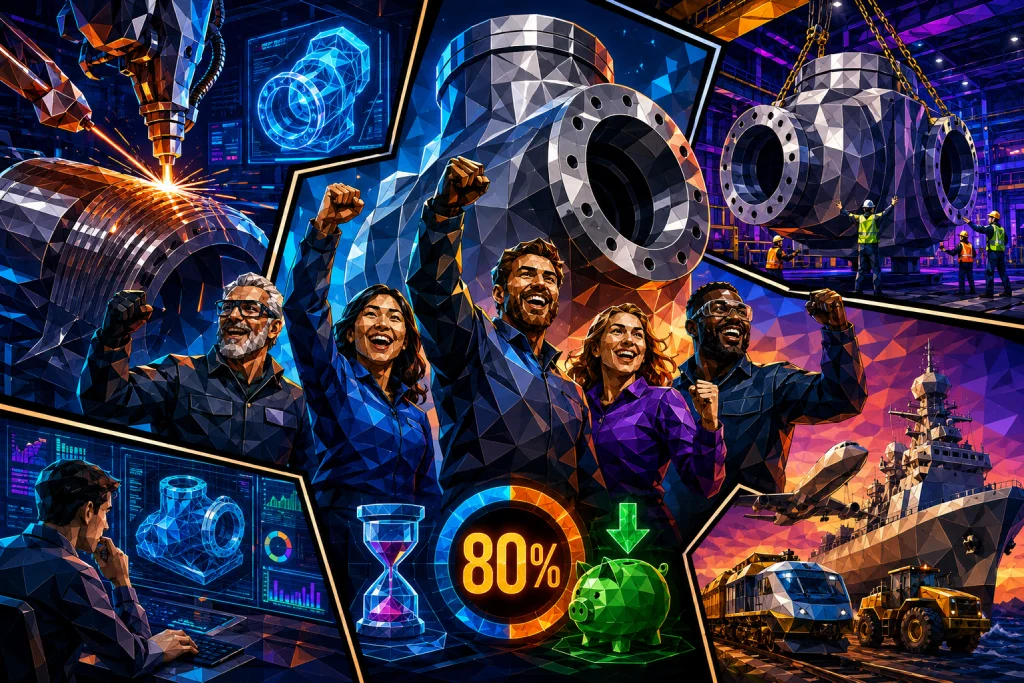
The shift from prototypes to large industrial components is achieved by implementing wire-based technologies like DED instead of traditional powder systems. This transition requires a focus on deposition rates and hybrid manufacturing. Companies should select technologies that allow for the rapid build-up of the main structure while maintaining precision on critical surfaces through targeted post-processing.
From prototypes to industrial series production with next generation metal technology
The industry is moving away from small test pieces toward the production of massive components weighing several hundred kilos. This shift opens up enormous savings if the right technological path is chosen. This article examines how the combination of wire-DED and precision methods radically reduces the actual 3D print time and total material costs in INR. We dive into the economic benefits of choosing wire-based systems over expensive powder solutions and explain how gradient structures inspired by nature can resolve the conflict between strength and flexibility in your parts.
You will gain insight into the latest market prices for industrial equipment and learn why a local 3D print service is often the most profitable solution for the industry. By understanding the interaction between 3D print time and material selection, your company can optimize the supply chain and significantly reduce waste.
Read the full article now and discover how to transform your production with the most effective 3D actions on the market.
From prototypes to large industrial components with 3D print
Strategic optimization of production through advanced technologies and hybrid manufacturing in our industry
Industrial production is undergoing a significant change. Where companies previously primarily used the technology for small precision items, our facility now produces massive components weighing several hundred kilos. This development is driven by the need to manufacture capital goods such as tractors, trucks, and ship components directly from digital drawings. A 3D print service provided by our team now delivers parts for everything from railway operations to engine rooms on aircraft carriers. These components must often perform for 30 to 50 years. We are seeing a shift away from small, fine details toward heavy parts where volume and reliability are the most important factors.
What is the economic advantage of wire-based 3D print over laser powder bed?
The economics behind production depend heavily on the chosen system and material consumption. A laser powder bed system for metal often costs over 360,000,000 INR if you want to build items over one meter. In comparison, a wire-DED system costs around 21,000,000 INR. Wire-based 3D print uses metal wire, which is significantly cheaper than the fine metal powder required for laser-based machines. By choosing wire, a company reduces both direct material costs and the need for expensive safety facilities. A wire-DED 3D printer does not require a closed chamber with inactive gas, as local shielding gas is used directly at the nozzle.
How much can you reduce your 3D print time by choosing DED technology for large items?
Production speed determines the final unit price. For large items, the laser powder bed process is often too slow, as the system must spread a new layer of powder every few micrometers. Wire-DED deposits material continuously, which removes repeated pauses in the process. By using technologies such as cold spray, a deposition rate of up to 100 g/min is achieved. This shortens the total 3D print time from weeks to days. This efficiency makes our 3D print service profitable for the series production of large flanges and manifolds that otherwise require long-term machining.
How does the combination of wire-DED and precision 3D print work in practice?
The most effective strategy combines different technologies into one hybrid solution. One should use wire-DED to build the 3D print of the coarse main structure. This removes the need to mill away large amounts of material from a solid block. Subsequently, fine details or complex cooling channels should be added via precision 3D print on the critical surfaces. One should only post-process the surfaces that will function as assembly points. This method ensures an optimal balance between production speed and the necessary tolerance for industrial machines.
Which materials are best suited for industrial 3D print of large parts?
The choice of metal determines the lifespan and performance of the part. Our team often works with 6000 and 7000 series aluminum, which is traditionally difficult to weld without cracking. 3D print solves this challenge through controlled heat input. For extreme environments, one should choose nickel superalloys like Inconel 625 or refractory metals like tungsten. Tungsten only melts at 3422 degrees Celsius and therefore works excellently in high-temperature environments. We also offer 17-4 PH and 316L stainless steel for components that require high corrosion resistance.
How can gradient structures in 3D print resolve the conflict between strength and flexibility?
Nature has perfected gradient structures over millions of years. We see it in bones and teeth, where the material changes properties from the surface to the core. With industrial 3D print, components should be designed with a hard, wear-resistant exterior and a tough, flexible interior. This gradual transition in the material’s structure removes the classic compromise between strength and elasticity. Gradient materials resist fatigue and cracking better than uniform items. This technology is ideal for offshore equipment exposed to constantly changing loads and high pressure.
How are the total costs for a 3D printed industrial item calculated in INR?
The price calculation includes material, 3D print time, and post-processing. Since wire-DED produces items very close to their final shape, waste of raw material is minimized. A local 3D print service purchases metal wire in large quantities, which keeps the price down in INR. One should also include the savings on support structures, which in laser-based systems often constitute a large part of the waste. For large items, the price per kilo of the finished part drops significantly when choosing high-speed deposition over micrometer-level precision.
What does it cost to establish in-house production of industrial components with 3D print?
Investing in your own equipment requires major economic considerations. A professional office system like the Markforged Metal X costs around 4,200,000 INR for a complete package. If you want an industrial scale like the EOS M 290, the price exceeds 21,000,000 INR. Added to this are expenses for ventilation, handling flammable powder, and hiring specialists. For most companies, it makes better sense to use an external 3D print service. This removes technological risk and ensures access to the latest knowledge without tying up capital in machines that quickly become obsolete.
What should you be aware of when choosing 3D printer technology for industrial use?
The size and application of the part should be assessed before choosing the technology. Laser powder bed fusion delivers unsurpassed precision for small items but requires extensive post-processing such as heat treatment and mechanical removal from the build plate. Wire-DED is more robust and suitable for workshop conditions. One should also ensure full traceability through certifications like COC and COA. For industrial components, the mechanical properties of the material are more important than the visual finish. A coarse appearance means nothing if the internal strength properties match or exceed forged metal.
What are the most important advantages of choosing a local 3D print service?
Collaborating with a local partner ensures fast delivery and removes logistical challenges. We settle everything in INR, providing transparency in the budget. By producing locally, a company reduces its carbon footprint through shorter transport routes. Our 3D print service understands the international standards and requirements for industrial production. You get direct access to technical advice from our team, which minimizes the risk of errors in the design phase. This creates a stable supply chain where you can have spare parts delivered on-demand rather than waiting for shipments from abroad.
FAQ: Industrial 3D print of large components
When companies investigate the possibilities of scaling from prototypes to industrial series production, a number of technical and economic questions often arise. Below you will find answers to the most central topics regarding technology choice, material properties, and optimization of the 3D print itself for heavy industry.
Why should you choose wire-DED over laser powder bed for large items?
You should choose wire-DED for large items because of the significantly lower costs for equipment and raw materials. Metal wire costs substantially less than fine metal powder and enables faster 3D print time. Furthermore, the process does not require a closed chamber, which removes the need for investments in complex safety facilities and gas management.
Which materials work best for 3D print of large industrial parts?
Aluminum in the 6000 and 7000 series as well as nickel superalloys like Inconel 625 work best for large industrial components. These materials offer the necessary strength and corrosion resistance for demanding environments. One should also consider refractory metals like tungsten for high-temperature applications, as they retain their mechanical properties under extreme thermal loads.
How do you calculate the total 3D print time for heavy metal components?
The total 3D print time is calculated by analyzing the deposition rate measured in grams per minute combined with the volume of the item. Wire-DED and cold spray technologies significantly reduce time compared to laser-based methods. Time for any post-processing should be included to get a true picture of the total production time.
Can 3D printed metal match the strength of traditionally forged items?
Yes, 3D printed metal can match or exceed the strength of forged items through the use of gradient structures and precise heat management. By controlling the microstructure during the 3D print itself, a superior balance between strength and flexibility is achieved. This makes the technology suitable for critical components in both the offshore sector and the defense industry.
What does it cost to have large metal components manufactured in INR?
The price of large metal components in INR depends on material choice, 3D print time, and the necessary post-processing. By using a local 3D print service, you reduce logistics costs and avoid unnecessary waste of raw material. A precise calculation should always include the savings of printing near-net-shape rather than traditional milling.
Is it cheapest to buy your own 3D printer or use a 3D print service?
For most companies, it is cheapest to use a professional 3D print service rather than investing in their own equipment. Investment in industrial plants often exceeds 21,000,000 INR plus ongoing costs for operation and experts. An external partner removes technological risk and ensures access to the latest knowledge.
Strengthen your production with the 3D print service of the future
The shift to large industrial components with 3D print gives companies a significant advantage. By combining wire-DED with precision technologies, you achieve both speed and quality in production. Gradient structures enable solutions that were previously impossible to manufacture traditionally. The economy of our 3D print service is now so strong that the technology directly challenges traditional casting and milling for heavy industrial items. You achieve shorter delivery times, lower material costs, and better material properties by choosing the right partner for the 3D print itself.
Contact our facility today for a review of your 3D actions and hear how we optimize your industrial components.