
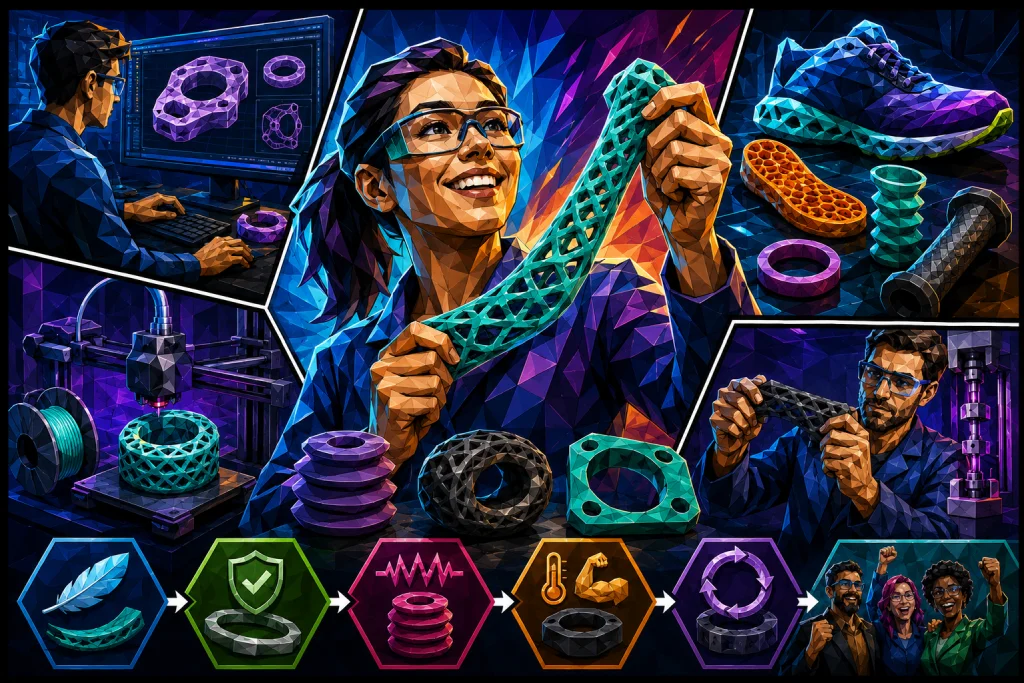
Master hardness, design rules, and material selection for industrial parts.
Many engineers and buyers mistakenly assume that 3D print is only suitable for rigid plastic prototypes. The reality, however, is that additive manufacturing today delivers fully functional, elastic parts that match or exceed traditionally molded rubber.
In this article, we review thermoplastic polyurethane (TPU) and the newer high-performance alternative PEBA. We look at the technical properties, design rules, and differences so you can choose the right material for your production.
What is TPU, and what properties do you achieve?
TPU acts as the bridge between hard plastic and soft rubber. The material excels in extreme wear resistance and the ability to absorb shocks without breaking. Unlike many other materials where layers can separate under load, a 3D print in TPU achieves exceptionally good layer adhesion. This means the part effectively melts together into a homogenous unit that rarely delaminates.
However, the technology is constantly evolving. While TPU is the industry workhorse for general tasks, we are now seeing the emergence of PEBA (Polyether Block Amide). This material combines the chemical resistance of nylon with elasticity. A significant advantage of PEBA is the weight. The material has a density of only 1.00 g/cm³ compared to TPU’s 1.16 g/cm³. This provides a weight saving of up to 20%, which is a critical factor for applications such as drones, robotic grippers, or handheld equipment where every gram counts.
Which Shore hardness fits your task?
When specifying a flexible material, we use the Shore A scale to define hardness. But you must be aware of an important technical nuance: the same Shore value does not necessarily mean the same stiffness.
A classic TPU material with a hardness of Shore 95A resembles the wheel of a shopping cart. It is flexible but holds its shape under pressure. If we compare this with PEBA at the same Shore 95A, we see a difference in stiffness (Young’s Modulus). Data shows that PEBA has an elastic modulus of up to 392 MPa, while standard TPU is around 20 MPa.
In practice, this means that even though the surface feels equally hard on both materials (Shore), a part made of PEBA will require much more force to be stretched or bent. For tasks such as shoe soles or soft grips where user comfort is important, you should therefore often choose a lower Shore value or a less stiff material than for industrial gaskets.
How do you design parts for flexible 3D print?
Designing for flexible materials requires different considerations than for rigid plastics. The material gives way during the printing process, which places demands on your file.
First, you should avoid support on large surfaces. Flexible materials bind extremely well to themselves and to the build plate. If you design a part with large, flat overhangs that require support, you risk the support material melting too well into the 3D print itself. This makes post-processing difficult and can leave unsightly marks. Therefore, design self-supporting structures with angles above 45 degrees as much as possible.
Second, we recommend using chamfers against the build plate. Since the adhesion to the build plate is very strong, you may find that the bottom of the part deforms when we take it off the machine. By adding a small chamfer on the bottom edge, you make it easier to get a spatula under the part without damaging it.
Finally, you must account for creep. All elastic polymers will deform over time if exposed to constant tension. TPU is no exception. You should therefore not design parts intended to be under constant static tension (like a rubber band that is always stretched), as the material will slowly lose its elasticity.
Where does the industry most often use TPU 3D print?
The choice between materials often depends on whether you want to absorb energy or return it.
Standard TPU has a low energy return (typically 30-60%). This means the material “deadens” impacts. It is ideal for vibration dampers, machine feet, and protective caps where the goal is to remove tremors and protect equipment.
PEBA, on the other hand, delivers an energy return of up to 78%. If you drop a ball made of PEBA, it bounces back almost like rubber. This makes the material suitable for applications requiring “bounce,” such as sports equipment, spring components, or snap-fits that must click into place many times. Furthermore, tests show that PEBA has higher friction against surfaces like glass and paper, making it superior for drive wheels and rollers in transport systems.
Does your component work in a hot environment? Here, PEBA also exceeds the standard with a Vicat softening temperature of approx. 133°C compared to TPU’s 99°C. This opens up use in engine compartments and industrial machines where ordinary TPU would become too soft.
Why does TPU require specialized production equipment?
Many companies try to print flexible materials in-house but often experience quality issues. This is primarily due to two factors: moisture and friction.
Both TPU and especially the nylon-based PEBA are highly hygroscopic. They absorb moisture from the air in just a few hours. If the material is not dried correctly (often at 60°C for at least 4-6 hours right before use), the water will boil in the nozzle. This creates small bubbles in the part, weakens the strength, and ruins the surface finish. At our facility, we store materials in active drying cabinets throughout production to guarantee consistent quality.
Additionally, soft filament is difficult to control. It behaves like cooked spaghetti; if you push too hard, it just bends. We utilize specialized 3D printers with ‘direct drive’ extruders and precisely calibrated flow rates, ensuring the material is deposited accurately without blocking the nozzle. This ensures you get dimensionally accurate parts every time.
FAQ: TPU flexible 3D print
Here you will find answers to the most important technical questions regarding the use of TPU and PEBA in production. Whether you are in doubt about material selection, durability, or design rules, this section helps you take action and make the right decision for your next project.
Which Shore hardness should I choose for my part?
The choice depends on the desired stiffness and user comfort of the finished product. Shore 95A is the standard, resembling a shopping cart wheel, and is perfect for industrial dampers. If you want softer parts like soles or grips, you should choose a lower Shore value or PEBA, which feels less stiff.
What is the difference between TPU and PEBA filament?
PEBA is a high-performance alternative to TPU that is lighter and has better energy return. While TPU is ideal for absorbing shocks (damping), PEBA is perfect for parts that need to spring back (“bounce”). Furthermore, PEBA withstands higher temperatures up to 133°C and weighs approx. 20% less than standard TPU.
Is 3D printed TPU as strong as molded rubber?
Yes, 3D printed TPU often fully matches the wear resistance of traditional molded rubber. Thanks to the chemical structure, the layers melt together into an almost unbreakable unit during the printing process. This makes the material extremely resistant to tearing, abrasion, and chemicals like oil, which is ideal for demanding industrial environments.
Which design rules apply to flexible 3D print?
You should avoid support structures on large surfaces, as they bind too well to the part and are difficult to remove. We recommend designing self-supporting angles over 45 degrees and adding chamfers at the bottom to facilitate removal from the build plate. Additionally, avoid designs under constant static tension to prevent creep.
How high temperatures can TPU and PEBA withstand?
Standard TPU typically handles temperatures up to 99°C before losing its structural stability. If you need higher heat resistance, for example in an engine compartment, PEBA is the right choice with a Vicat softening temperature of approx. 133°C. Both materials, however, retain their flexibility well in the cold and are suitable for outdoor use.
Why should I not print TPU on my own printer?
Flexible materials are hygroscopic and require active drying to avoid bubbles and weak prints. Additionally, the soft filament requires specialized ‘direct drive’ extruders to avoid jamming. At our facility, we ensure professional drying and precise extrusion, so you get dimensionally accurate, strong parts every time without production errors.
Shall we produce your next flexible solution with TPU?
If you need a part that combines wear resistance with elasticity, 3D print in TPU or PEBA is often the fastest and cheapest way to reach your goal. You avoid expensive molds and can order everything from 1 to 500 units with short delivery times.
Upload your STEP file to our price calculator today and see what your solution costs in either standard TPU or our high-performance materials.