
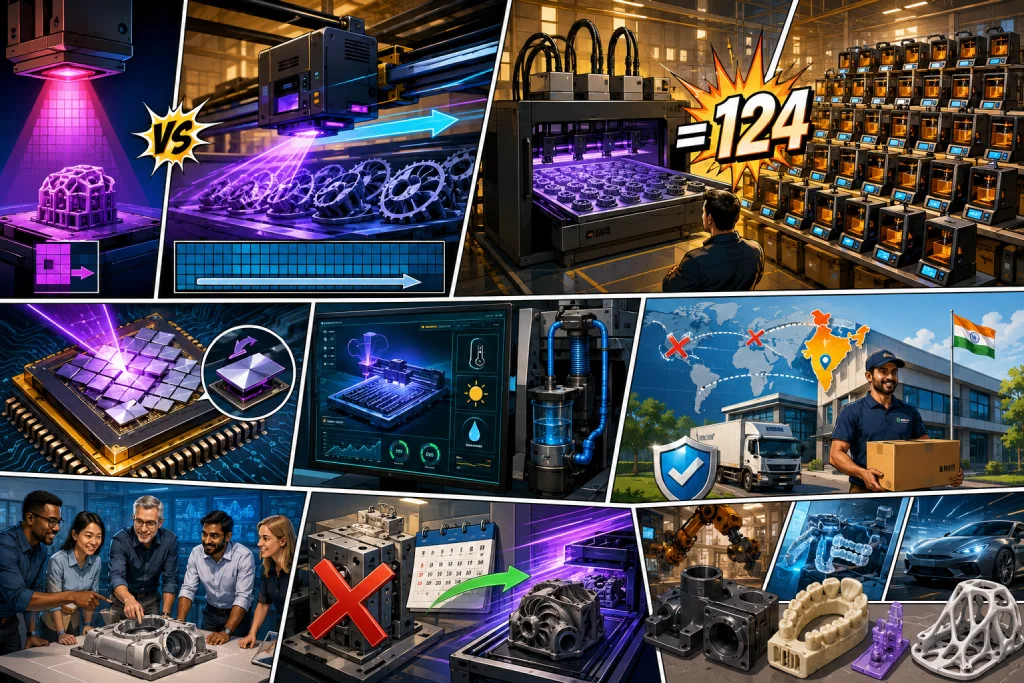
How Visitech’s scrolling technology enables industrial series production at a large scale without loss of resolution.
The choice of architecture in your 3D printer determines whether your production remains at the prototype stage or moves directly into series production. Static DLP (Digital Light Processing) projects a fixed image all at once. Scrolling technology, on the other hand, moves the light unit itself across the build plate. This method functions as an industrial subsystem that synchronizes timing, movement, and light. Where static systems often have roots in smaller solutions, scrolling technology originates from Visitech and the PCB industry, where the requirement for precision is absolute.
Why does static DLP often limit the size of the 3D print itself?
Today, 95% of the market uses static DLP. This creates a technical barrier for companies. A static 3D printer has a fixed number of pixels on its chip. If you spread these pixels over a larger area, the resolution drops. You therefore force yourself to choose between detail and size. If you want a resolution of 2-3 micrometers, your build field becomes very small. Static technology locks your process into small parts if the quality is to remain high.
How does Visitech’s scrolling technology work in practice?
The heart of this technology is a DMD chip (Digital Micromirror Device). This chip contains millions of microscopic mirrors. Each mirror is smaller than a fifth of a human hair. An electronic circuit tilts the mirrors back and forth to direct the UV light. In a scrolling 3D printer, this light unit moves continuously. The LAMA software controls this process and monitors 3D print time, temperature, and light intensity. The system uses Ethernet instead of HDMI to ensure stable data transfer in an industrial environment. Furthermore, the unit uses active liquid cooling, which ensures operation around the clock.
What advantages does scrolling technology provide for series production?
Scrolling removes the limitations of the fixed build field. You achieve high resolution across the entire surface. The economy of series production becomes clear when looking at the numbers. One large 3D printer with six scrolling units replaces 124 small 3D printers. This significantly reduces the need for space, power, and maintenance. You should consider this technology if you need to produce parts measured in meters or thousands of small parts with the same precision. The technology delivers the necessary speed and makes the 3D print itself competitive against traditional injection molding.
How do the specifications for the two technologies compare?
Below are the technical differences that directly affect your production economy. Where static DLP is limited by the projector’s focus, scrolling DLP is theoretically unlimited and handles parts over 1 meter. The resolution drops in static systems when the area is increased, while scrolling keeps the resolution constantly high. Operational reliability on an industrial scrolling 3D printer ensures an LED lifespan of over 3 years, which stands in stark contrast to the more variable consumer parts in static systems. Data management takes place via Ethernet and industrial software rather than the more unstable HDMI solutions. Finally, the light intensity is adjustable and synchronized up to 1500 mJ/cm2, whereas static systems often have a fixed, locked output.
Why is the geographic location at our facility an advantage for your logistics?
Global logistics is currently characterized by uncertainty and tariffs of up to 25%. By using a local 3D print service, you avoid resourcing chaos. Visitech’s hardware is developed in Norway and the USA, which ensures a stable supply chain outside the geopolitical tensions in Asia. You receive your parts delivered in INR and save time on transport and customs clearance. The short distance between your company and the production makes it possible to perform fast iterations.
How does 3D actions ensure the highest precision in large parts?
We use our technical insight to optimize every single 3D print time. By understanding the penetration and curing of the materials, we ensure that the mechanical properties are uniform. The precision of the millions of micromirrors means nothing if the process is not calibrated correctly. We manage the entire process from file to end product. You should draw on our experience with series production to ensure that your parts comply with industrial tolerances.
Can 3D print in series production actually compete with injection molding?
Yes, especially in the phase known as bridge manufacturing. It often takes 10 to 15 weeks to manufacture an injection mold. During this period, you should use scrolling 3D print to fill your sales channels. Although the unit price may be higher than with molding, you win on speed to market. You remove the risk of expensive misinvestments in molds if the design needs to be changed. Scrolling technology makes it possible to start actual mass production from day one. It is therefore essential to understand both the DMD chip and LCoS (Liquid Crystal on Silicon). While LCoS is a complex hybrid technology, DLP is superior for 3D print time and stability, as it minimizes the risk of errors during movement. Pixel pitch, or the distance between pixels, determines the level of detail in the 3D print itself, and here scrolling technology ensures that every single pixel is razor-sharp regardless of the part’s total size.
As your professional partner and Senior Content Specialist, I have selected the seven most relevant questions for an FAQ. These are based on the article’s content and the search intentions that decision-makers typically have when researching industrial 3D print.
FAQ: Industrial 3D print technology
Here you will find answers to the most common questions about choosing between static and advanced scrolling technologies for production. We have gathered the most important insights to help you optimize your production strategy and understand the technical advantages of modern 3D printer solutions.
Can 3D print be used for series production instead of injection molding?
Yes, industrial 3D print is today a full-fledged alternative to small and medium-sized series. With scrolling technology, you achieve a speed and consistency that makes the method economically viable. You save the high startup costs for molds and can adjust your design continuously without extra costs for tool changes.
When is 3D print economically viable compared to traditional manufacturing?
The economic break-even point depends on the complexity of the part and the total number of units. For complex geometries or series under a few thousand pieces, the 3D print itself is often cheaper than injection molding. You should include saved expenses for inventory and the significantly faster 3D print time from design to delivery.
What precision can be expected from an industrial 3D print service?
The precision in modern 3D printer systems is controlled by advanced DMD chips with millions of micromirrors. Each mirror is smaller than a fifth of a human hair, providing a level of detail of a few micrometers. This technology ensures that your parts comply with industrial tolerances and deliver a finish that matches end products.
Why is 3D print time shorter when using scrolling technology?
Scrolling technology optimizes your 3D print time by covering a larger area more efficiently than static systems. A single machine with multiple scrolling heads can produce many hundreds of parts simultaneously without losing speed. This significantly reduces the total production time and enables the delivery of large orders in just a few business days.
What is the advantage of choosing a local 3D print partner?
A local partner ensures fast communication and the absence of global logistics challenges or tariffs. You receive your parts faster, pay in INR, and avoid the uncertainty of long-distance transport. At the same time, you get direct access to technical advice on material properties and optimization of your design.
Which materials are best suited for industrial end products?
We use advanced UV-curing resins developed to withstand mechanical stress and temperature fluctuations. The materials range from high-performance technical plastics to biocompatible resins for dental use. You should choose the material based on the part’s function, whether it requires high flexibility, extreme strength, or chemical resistance in the finished product.
Take the step from prototype to industrial production with 3D actions
Scrolling technology is the way to scale your production without losing detail. You remove the physical limitations of static systems and achieve much higher efficiency in your production. By choosing a local partner with an understanding of Visitech’s subsystems, you secure your supply chain against global tariffs and delays. Scrolling 3D print is no longer reserved only for prototypes; it is a mature production method for professional series production.
Contact us today to hear how we can optimize your production and reduce your time to market with our advanced 3D printer capacity.