
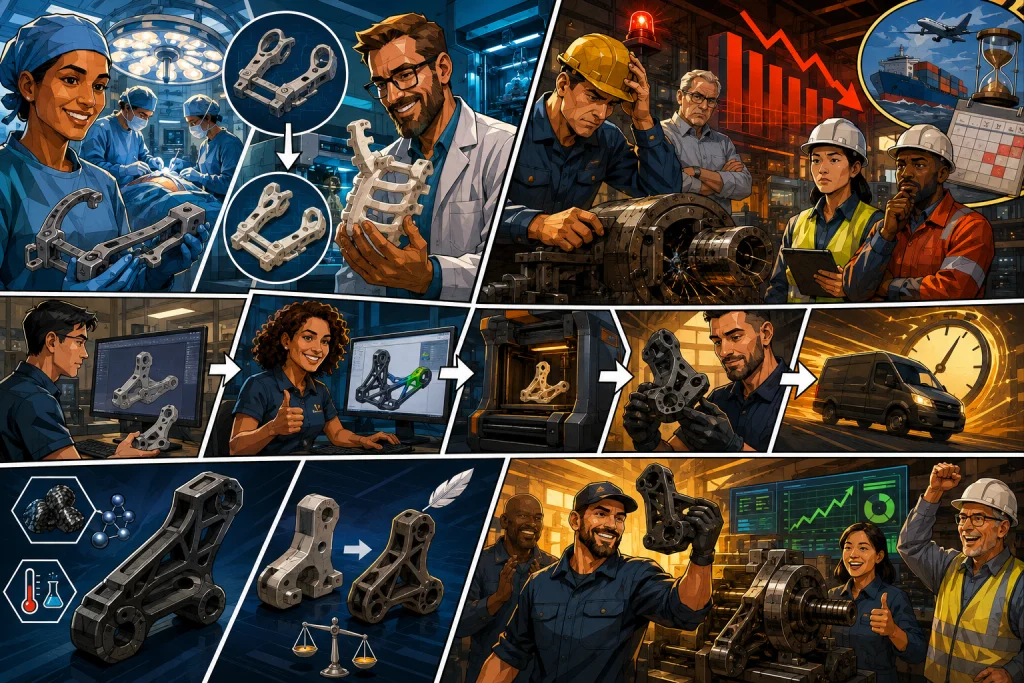
From the operating room to the production hall: How to minimize critical downtime with on-demand production.
In hospitals, doctors measure success in minutes. When a surgeon is in the middle of a complex operation, waiting time is not an option. Every minute counts for the patient’s survival. The world’s leading hospitals have therefore built dedicated departments of up to 900 m² with specialists working exclusively with Point-of-Care Manufacturing. They produce surgical guides and implants directly at the hospital, exactly where the need arises.
Companies should transfer this logic directly to the production floor. While it is about human lives in the hospital, it is about the company’s lifeline on the factory floor: the machines. If a critical machine stands still, the company bleeds money. Nevertheless, many production managers accept lead times of weeks for spare parts that they could have produced locally in a few days. Here we review how you transfer the efficiency from the operating room to your production line, and why 3D print service should function as your factory’s emergency generator.
Why is downtime the most expensive factor in your production?
Downtime is the silent killer of industry. Many companies focus narrowly on the purchase price of a spare part. The question is often whether a gear costs 6,000 INR or 60,000 INR. But the real cost rarely lies in the part; it lies in the waiting time. Experience shows that an advanced operating room costs between 6,500 and 8,500 INR per minute to run due to depreciation and personnel. If you transfer that calculation to a high-performance production line, you quickly see the same picture.
Your OEE (Overall Equipment Effectiveness) drops drastically during unplanned stops. Downtime costs far more than the spare part itself due to the massive production loss. If a line stands still for 14 days, the loss far exceeds the price of a 3D printed spare part that can be delivered in a few days. Your machine operators function as First Responders. They are at the machine when the accident occurs. If they lack the right tool or the right spare part, production stands still. Instead of only reacting to breakdowns, you should use smart sensors and data to predict the need. But when the accident strikes and you do not have the part in stock, the lead time becomes the most expensive factor in your budget. Traditional supply chains are vulnerable to long lead times from Asia or the USA, requirements for minimum orders, and spare parts that become obsolete and can no longer be sourced.
How does 3D print technology save lives and bottom lines?
More and more hospitals use 3D print technology to remove uncertainty. A concrete example is a so-called Sternal Retractor. Surgeons lacked a specific clamp to hold the chest open during complex heart operations over several stages. The industry offered no solution. The team drew a solution on a whiteboard, and less than a month later, they used the first 3D printed version in the operating room. Today, they produce them in large series. They did not wait for the market to solve the problem; they printed the solution themselves.
In industry, the technology is just as mature. Materials like Carbon-reinforced PA12 or PEKK match or exceed the properties of traditionally milled aluminum or molded plastic. When we talk about 3D print business, we are talking about fully functional end components that resist chemicals, high temperatures, and constant mechanical stress.
How is the logic transferred from the operating room to the factory floor?
Imagine your production as the patient. When a critical component fails, the line suffers a cardiac arrest. You have two choices. The traditional treatment involves ordering a spare part and waiting for order confirmation, shipping, and customs clearance. You hope the part fits when it arrives in 14 days. The alternative is the acute model via 3D print. Here you send a digital file (STEP or STL) to our team. We produce the part locally, often within 24-48 hours, and send it directly to your factory.
A leading hospital experienced this with a young patient who needed a special tracheostomy tube to avoid it chafing into her spine. Commercial suppliers rejected the task because there is no profit in single-piece production. The 3D print department solved the task because they focused on the need, not the volume. Industry experiences exactly the same when suppliers make critical spare parts obsolete. Here, DfAM (Design for Additive Manufacturing) gives you an extra advantage. We do not just print a 1 to 1 copy; we optimize the part. We can make it lighter, stronger, or combine several functions into one component, making maintenance faster and safer for your operators.
How does 3D print service reduce lead time from weeks to hours?
The solution requires a shift to a digital inventory. A digital inventory means that you store your spare parts as digital files rather than physical objects on a shelf. The parts are only produced when they are needed on-demand, which saves storage space and ensures against obsolescence. When the need arises, we press the start button.
Some companies consider buying their own printers to achieve this flexibility. But even large hospitals spent several years validating their titanium printer before they could use it for critical purposes. It requires enormous knowledge of calibration, materials, and post-processing. By using an external partner like 3D actions, you achieve the advantages of local production – the speed and flexibility – without having to operate the machine park yourself. We have already taken the fight with validation and maintenance, so you receive a finished, quality-assured part. By using a local 3D print service, international freight and customs are eliminated, and with a digital inventory, production starts immediately, reducing lead time from weeks to days.
What economic gain is achieved by on-demand spare parts?
We must look at the Total Cost of Ownership (TCO). A traditional spare part might cost 1,200 INR to purchase. But if it costs 12,000 INR in storage space over 5 years, and 600,000 INR in lost production while you wait for it, the price increases drastically. Examples from the USA show that a custom-made titanium implant from an industrial supplier can cost up to 4,200,000 INR. By producing it in-house or via a specialized partner, the price can be reduced significantly, but the greatest value lies in the availability.
The 3D print itself might cost 6,000 INR. It is more expensive in pure purchase price than the mass-produced part. But if the lead time falls from 2 weeks to 2 days, you save 12 days of production loss. You remove the risk of global logistics and get the opportunity to continuously change the design if the need in production changes.
FAQ: 3D print in industry
Here you will find answers to the most important questions about how industry can use 3D print technology strategically to minimize downtime and optimize the supply chain.
What can industry learn from hospitals about 3D print?
Industry should learn to treat machine breakdowns with the same emergency preparedness as surgery. By using local on-demand production, expensive waiting time for critical spare parts is removed. Just as the hospital saves lives by acting quickly, factories can save the bottom line by switching from slow supply chains to fast, local manufacturing.
How fast can your team deliver a critical spare part?
We can often deliver finished items within 24 to 48 hours for acute cases. Since production takes place locally, you eliminate waiting time for international freight and customs. With a digital inventory, we can initiate your production immediately, as soon as the need arises on the factory floor.
Is a 3D printed spare part more expensive than a traditional part?
No, not when you include the total costs of downtime in production. Although the unit price of the 3D print itself can be higher than a mass-produced item, the savings from avoiding weeks of production stops are far greater. Total Cost of Ownership therefore often becomes lower with on-demand production.
Can 3D printed materials replace metal in machines?
Yes, advanced materials like Carbon-reinforced PA12 and PEKK are extremely strong and heat-resistant. In many cases, they can replace aluminum and steel while reducing weight. We often use DfAM to optimize the design so the 3D printed part performs better than the original metal part.
What is a digital inventory, and what value does it create?
A digital inventory is the storage of spare parts as data files instead of physical products. You have the drawings ready, and we produce them only when you need them. It frees up tied-up capital, saves expensive square meters of warehouse space, and protects you against vital spare parts becoming obsolete at the manufacturer.
What does Point-of-Care Manufacturing mean in an industrial context?
It covers production located as close to the site of use as possible to increase speed. For industry, this means using a local service partner as an integrated part of the factory. This ensures fast response and close dialogue about the solution without you having to operate the machines yourself.
How do I get started using 3D print strategically?
You should start by identifying the spare parts that create the greatest risk for long-term downtime. Send your files to us at 3D actions, and we will evaluate if they are suitable for production. We advise on material selection so you can test the technology on your most critical bottlenecks.
Strategic risk management rather than simple spare part purchasing
The lesson from the hospital world is clear: The one who reacts fastest and most precisely wins. For the hospital, it applies to the patient’s health; for your company, it applies to competitiveness. You should not replace all traditional manufacturing with 3D print. You should use it as strategic risk management.
Identify the 5 to 10 most critical spare parts in your production – the ones that hurt most to be without. Analyze the data from your breakdowns. At 3D actions, we evaluate your files and advise on material selection, so you go from vulnerable to secured. Knowledge beats hardware, but only if you act on it.