
How to achieve industrial tolerances and reduced 3D print time through process integration and advanced milling
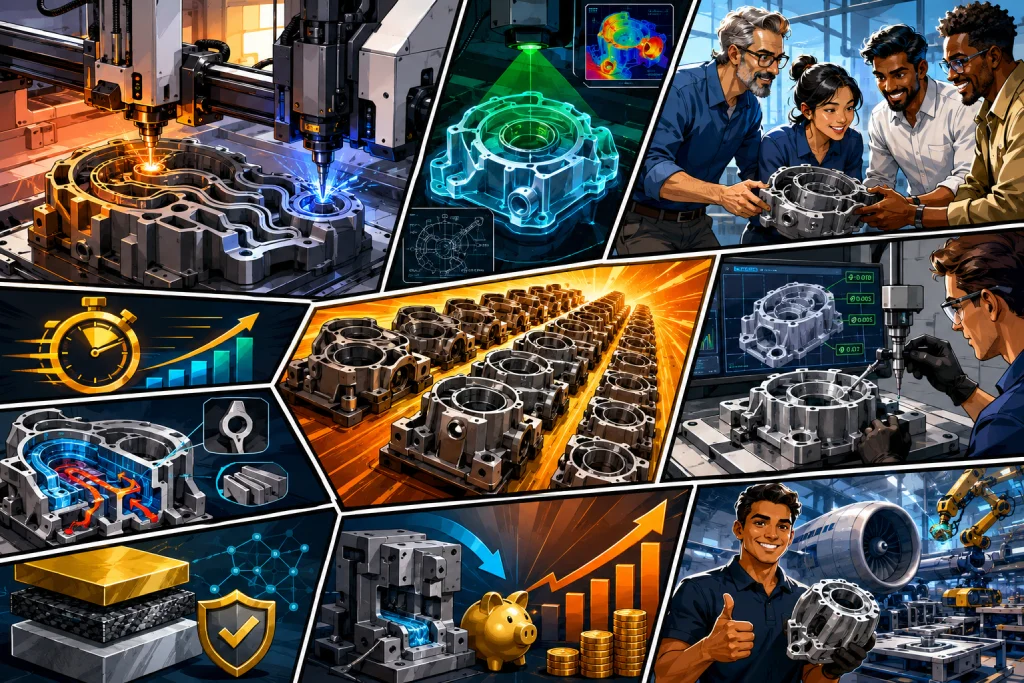
Hybrid production unites two worlds by combining additive production with subtractive machining in a single integrated workflow. At 3D actions, we no longer view the technologies as isolated tools, but as an integrated solution for complex industrial parts. We utilize an advanced machine with two independent bridges, a so-called dual-gantry solution. While one bridge builds the part layer by layer, the other bridge works with milling and scanning the surface. This form of process integration removes the need to move the part between different machines. It eliminates classic setup errors and significantly reduces the total lead time for your production. [3D print service business]
Why the 3D print itself often only constitutes 80 percent of the finished solution
Experience from large industrial players has shown that the 3D print itself rarely lives up to the strictest requirements for precision and surface quality. We view the first 80 percent of the production phase as a rapid shaping of the part. The final 20 percent of the quality is secured through mechanical post-processing. Without milling, the 3D print itself will often suffer from geometric deviations such as sagging at the top of holes or minor inaccuracies in the surface. By combining technologies, we ensure that all critical fits comply with your technical drawings every single time.
Optimization of total 3D print time through the hybrid mindset
You should prioritize speed in the actual build-up of the part rather than an extremely fine surface finish directly from the printer. We continuously monitor the thermal balance in the material with heat-sensitive cameras. This control makes it possible to increase speed without weakening the strength of individual layers. We often design parts with temporary layers over openings to avoid time-consuming support structures. This approach reduces your total 3D print time, as we quickly remove the redundant layers with the milling head as part of the automated process.
Internal features and cooling channels through advanced process integration
Traditional production methods have historically struggled to create complex cooling channels inside closed turbine components or tools. Hybrid production solves this challenge by building the part in sections. We mill the internal surfaces and cooling channels completely smooth while they are still accessible to the machine. Then we continue to print and thereby close the geometry. The result is components with an internal surface quality and precision that was previously impossible to achieve. You should choose this method for parts where optimal fluid flow and cooling effect are crucial for the end product’s performance.
Benefits of combining print and milling for series of 100-500 parts
When your series production is between 100 and 500 parts, the hybrid method minimizes your financial risk. Industrial parts in this size range often weigh between 680 and 900 kg. With prices for technical plastics between 3,600 and 9,000 INR per kilo, production errors become extremely expensive. We manage the economy by applying a multi-material strategy. Here we print a strong core in an affordable standard material and only apply expensive, wear-resistant, or corrosion-resistant coatings to the critical surfaces. This strategic use of materials ensures a high ROI without compromising the overall strength of the part.
Design of holes and tolerances for perfect post-processing
We apply specific design rules to prepare the 3D print itself for the final milling. A perfect circle in a CAD program is often affected by gravity during the actual production. We therefore often design holes with a teardrop-shaped tip at the top to avoid bridge errors. For precise assemblies, we integrate ribs and fins that allow the material to deform in a controlled manner during mounting. You should implement these technical details in your fixtures to achieve a stable gripping force. These refinements ensure that the post-processing leaves a hole with completely sharp tolerances and perfect roundness.
Precision through 3D scanning and digital quality control
Quality assurance at our team starts with a complete scan of the 3D print itself before the milling head ever touches the part. The scan reveals exactly how the material has reacted to the heat and whether any internal stresses have developed. We then adjust the machine’s coordinate system digitally based on the scanning data. This means that the milling head always hits the correct points, regardless of whether the part has contracted slightly during cooling. This validation ensures that we remove exactly the amount of material required to meet the desired ISO standards. You receive a part where every single detail is documented and verified.
Financial gains and reduced inventory binding with hybrid production
Choosing a hybrid approach at 3D actions saves you significant amounts in INR. You eliminate the high initial costs of molds in wood or metal, which normally slow down new projects. Hybrid production removes the need for expensive special tooling and makes it possible to produce on-demand. This reduces your inventory binding and frees up capital for other parts of your business. At the same time, the method gives you the freedom to update your design continuously without having to discard expensive tools. This shortens the path from prototype to finished series and strengthens your position in the market.
FAQ: Hybrid production and industrial 3D print solutions
Here you will find answers to the most common questions about how we at 3D actions combine the latest technologies in printing and milling to ensure your production achieves the highest precision and the best total economy.
Why should one choose a hybrid solution over standard 3D print?
You should choose a hybrid solution when your parts require precise fits, bearing seats, or a smooth surface finish. While the 3D print itself creates the complex base shape quickly, the subsequent milling ensures that critical surfaces meet industrial standards and ISO requirements for high-quality mechanical components.
How much 3D print time can be saved by using hybrid production?
You save significant 3D print time by printing the part with coarser layers and higher speed. Since we mill the outer surfaces to perfection anyway, the 3D printer does not need to run with fine settings. This reduces production time significantly and makes it cheaper to manufacture large, complex series.
Can 100 percent precision in holes be achieved with the 3D print itself?
No, the 3D print itself alone can rarely deliver 100 percent round holes with precise tolerances due to thermal shrinkage and gravity. By applying hybrid techniques, we mill the holes after printing, which removes ovality and ensures that bolts, shafts, and bearings fit perfectly in the finished industrial parts.
Which materials work best for industrial hybrid production?
High-performance polymers such as Ultem, PPS, and carbon-fiber-reinforced ABS work optimally for hybrid production at 3D actions. These materials possess the necessary strength to both be printed in large formats and subsequently machined with high precision, making them ideal for everything from aerospace to tool manufacturing.
How do scanning and quality control ensure accuracy in the process?
Scanning ensures accuracy by mapping all geometric deviations in the 3D print itself before milling begins. By loading the scanning data into the machine’s control system, we can compensate for material shrinkage and warp digitally. This guarantees that the final machining removes exactly the right amount of material for a perfect result.
Why is hybrid production cheaper for series of 100 to 500 parts?
Hybrid production is cheaper because you eliminate the extremely high initial costs for molds and special tooling. For series of 100 to 500 pieces, we can optimize material consumption in the 3D print itself and reduce manual post-processing, which lowers the price per part in INR and minimizes your financial risk significantly.
Realize your next industrial series with full precision
You should involve our team early in your development process to get the maximum benefit from hybrid technology. Our specialists help choose the right material for your specific operating environment and calculate the most efficient route for production. We analyze your files to optimize both 3D print time and the subsequent milling operations. When you send your projects to 3D actions, you secure a partner with deep insight into the entire value chain—from the first layer of plastic to the final precision measurement.
Contact us today for a review of your technical needs and get a non-binding overview of your production possibilities.