
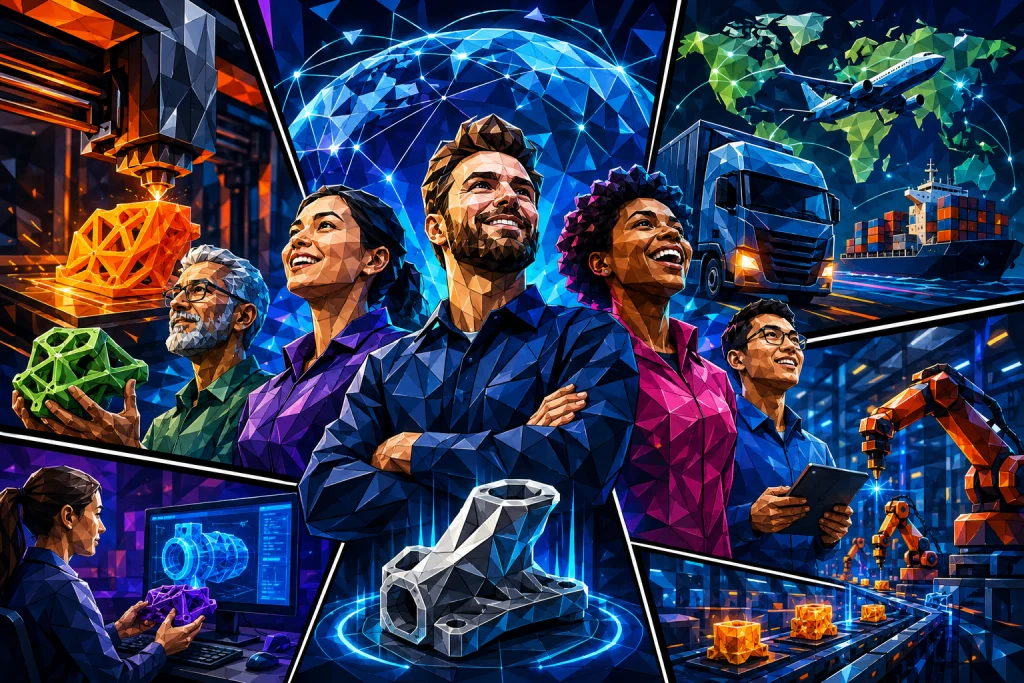
You should transform your production with local on-demand technology to ensure an agile and cost-effective supply chain.
Supply chains quickly become vulnerable to global disruptions. You should integrate the 3D print itself into your overall strategy to create a decentralized production that does not depend on long shipping routes. Companies minimize risks by producing locally and on-demand. You should use the technology to create an agile operation that quickly adapts to the market, which makes your supply chain more robust. On-demand production means that you only manufacture goods upon actual orders, which removes inventory costs.
[3D print business]
Why is the technology behind it secondary as long as the 3D print itself meets your industrial requirements?
Companies often focus too much on the specific 3D printer or the process behind it. You should always prioritize a finished product that meets the technical requirements rather than the brand of the machine.This point applies especially to industrial items such as medical implants, where specifications are critical. We ensure that the 3D print itself always meets your standards throughout the entire process. You should choose a solution that focuses on the result and the quality of the 3D print itself rather than the machine architecture itself.
When is it most effective to use a 3D print service rather than owning your own 3D printer?
The choice between in-house production and external service depends on the real costs, which often extend far beyond the price of the machine itself. Many small players license through platforms like Patreon or Thangs just to be allowed to use files commercially. You should include electricity, filament, and maintenance of your 3D printer, as well as the hidden expenses for post-processing.
A 3D print service removes these fixed expenses, as you only pay for the finished items and avoid the risk of capital binding in machines that might stand idle. The time you save by avoiding failed prints and repairs should instead be spent on your core business.
How much should your company save by optimizing your 3D print time through an external partner?
You should use efficiency as your primary competitive parameter in a crowded market. Traditional production methods often have long lead times, which covers the time from when you place an order until you receive the finished product.
Optimizing your 3D print time makes it possible to react to demand immediately. Automated management of 3D print time and each 3D printer removes unnecessary waiting time in the production flow. You minimize your inventory costs and free up capital for other purposes. You should replace uncertain forecasts with rapid production managed precisely through advanced toolpaths. A toolpath is the digital instructions that control how a 3D printer moves to create the item.
How do we ensure that every 3D printer delivers consistent quality when scaling from prototype to series production?
Series production requires industrial precision that a standard hobby machine can rarely deliver. Modern industrial systems use 40 kw laser systems with 75 lasers to ensure both speed and quality. Software and technical experience ensure consistent results every time, regardless of the order size. Our team uses this knowledge to produce your series through verified processes. You should choose validated processes for your industrial materials to avoid weaknesses in the items. We remove the challenge of material safety by managing every single 3D printer in the process with a steady hand.
What are the concrete economic benefits of settling in INR and producing locally?
A local partner gives you a full overview of your finances without surprises from exchange rates. Local supply chains save you from enormous transport costs and reduce your total CO2 emissions. You avoid uncertainty about customs and global licensing agreements that are often invoiced in foreign currency. A professional 3D print service removes the need to pay external designers. You should look at the total savings by removing the risk of failed prints, as the service partner bears this loss. Furthermore, local delivery ensures a significantly shorter lead time compared to production abroad.
How do you combine knowledge of design and production to create better end products?
You should understand the connection between design and manufacturing to get the best result from the 3D print itself. Many companies learn Fusion 360 to be able to create their own unique solutions and avoid being dependent on others’ files. You should collaborate with an expert to make your 3D designs ready for production, so you avoid unsuitable geometries. We help you translate your ideas into physical products that exploit all the advantages of a modern 3D printer without the limitations of traditional molds.
FAQ: Industrial production and supply chains
Below you will find answers to the most common questions about the integration of modern production technology. We have gathered the most important insights to help your company optimize the process from the first prototypes to the final series production.
Is it cheaper to use a service than to own your own 3D printer?
It is often more profitable to use a service rather than operating your own 3D printer for industrial use. You avoid ongoing expenses for software licenses, maintenance, and electricity, which quickly add up to many INR each month. A professional partner like 3D actions also ensures consistent quality.
What does the 3D print itself cost for companies?
The price of the 3D print itself depends on the size of the item, choice of material, and the necessary post-processing for your specific task. With our team, everything is always settled in INR, which ensures full transparency without unexpected customs fees. You should focus on the total savings by removing capital binding in very expensive machines.
How does your 3D print time affect the overall delivery time?
Your 3D print time acts as a crucial factor in shortening your total lead time in production. By optimizing the process through advanced algorithms and professional machines, you can deliver finished items significantly faster than with traditional manufacturing. You should use this speed as a competitive parameter.
Can the 3D print itself be used for industrial series production?
Yes, the 3D print itself is today fully suitable for industrial series production at a very high quality. Modern technologies like LPBF make it possible to manufacture complex metal components that meet all technical requirements. You should exploit this technology to produce items without expensive molds.
Which materials can you use for the 3D print itself?
You can choose from a wide selection of industrial materials for the 3D print itself, including both advanced polymers and strong metals. Each material requires a specific setup of your 3D printer to ensure maximum strength. You should consult with an expert to choose correctly.
Why should you choose a local 3D print service?
A local partner ensures fast delivery and easy communication without time differences or language barriers in daily life. By using 3D actions, you support local production and get access to technical advice close to your company. You should choose locally to reduce the environmental footprint.
Start your journey toward smarter production today
You should choose a partner who understands your logistics and technical requirements down to the smallest detail. The 3D print itself should be a fixed and integrated part of your supply chain to ensure maximum flexibility.
You reduce your costs and decrease waste by producing locally and on-demand. By optimizing your 3D print time and removing capital binding in heavy machines, your company stands stronger in global competition.
You should contact us to hear more about how we can optimize your production and secure your deliveries through professional 3D print technology.