
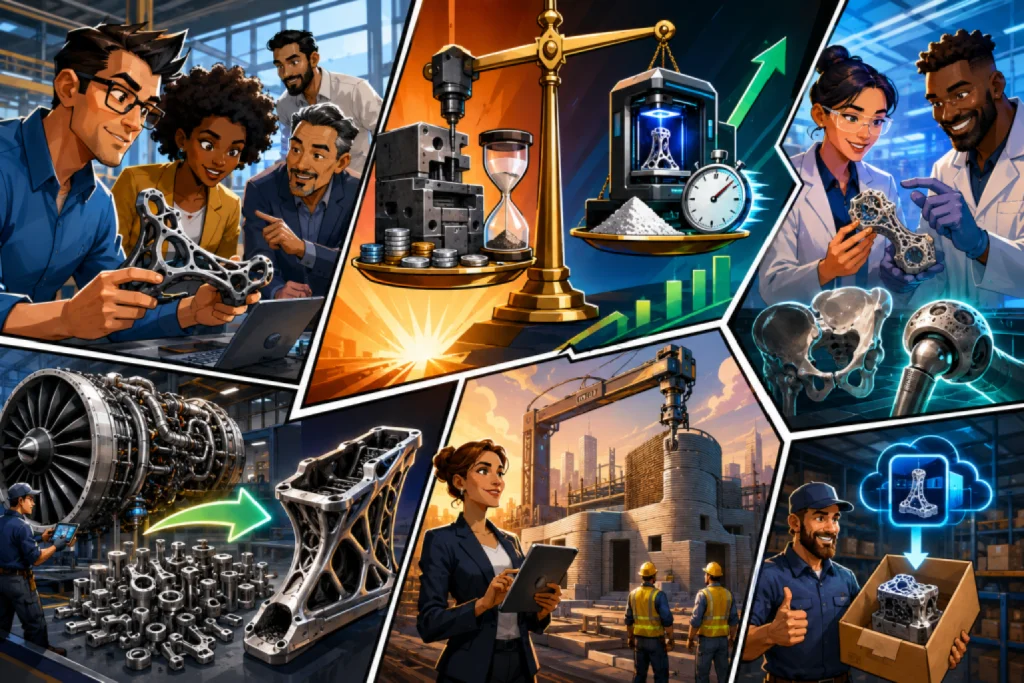
From price per kilo to competitive advantage – how to calculate the true value of industrial production
Purchasers and production managers often stare blindly at the price per kilo. When a kilo of plastic granules for injection molding costs 240 INR and a spool of filament or a kilo of powder for 3D print costs 6,000 INR, the equation immediately looks like a losing case for additive technology. This simplified calculation ignores the reality of modern industrial production. The price of the raw material in many cases constitutes a vanishingly small part of the total value when we analyze the finished product.
When you shift focus from price per gram to price per solution, the picture changes drastically. In industries where downtime costs thousands of INR per hour, or where an optimal design significantly reduces fuel consumption, the material price is insignificant. Expert Scott DeFelice refers to the raw material price as “de minimis” in these contexts. This means it disappears in the larger calculation because the value of the solution the technology delivers is so much higher than the cost of the plastic or metal.
Why is the material price a false friend in the budget?
If your company produces simple plastic cups or disposable cutlery, the raw material price means everything. Here, you compete on margins, and 3D print is rarely the right solution for simple “non-structural widgets.” The technology proves its worth when the requirements for the part increase and complexity grows.
One can compare the transition to industrial 3D print with the shift from an analog film camera to a digital camera. In the old world, which corresponds to subtractive manufacturing or casting, the “film” was expensive. Every new attempt required a new tool, a new mold, or a slow machine setup. You paid dearly to take the picture every single time, making innovation risky and slow.
With 3D print, which corresponds to the digital camera, the iteration costs almost nothing in time or tooling. You correct the file digitally and start your 3D printer again. This flexibility cuts up to 90% of development time. A traditional development process for a medical implant typically takes one and a half to two years. With a digital 3D print process, companies now send finished, patient-specific implants out the door in just two days. When you reduce time-to-market from years to days, the price of the powder becomes irrelevant. The expensive element is not the material, but rather the waiting time and lost sales while waiting for tools.
What does “Stacking USPs” mean for your bottom line?
The business case for 3D print holds water when you stack your unique selling points, also known as USPs. If your only advantage is speed, you still risk ending up in a price war. When you instead combine several technical advantages in one part, you create a value that traditional manufacturing will never be able to match.
A clear example is seen with the material PEKK in the medical industry. Here, several properties are stacked on top of each other. The material has a mechanical strength that matches bone tissue, which is essential for patient comfort. At the same time, the surface is bacteriostatic, so bacteria do not grow on it, reducing the risk of infections. The material also exhibits osteoconductivity, meaning bone tissue grows onto the implant, and finally, it creates no immune response, so the body does not reject it. No traditional milled titanium plate delivers this entire package of advantages. The value here lies in the patient’s recovery and fewer re-operations, justifying a higher material price.
In the aerospace industry, we see the same pattern through the phenomenon of Part Consolidation. An aircraft engine traditionally consists of hundreds of parts that must be welded, bolted, and assembled together. With advanced metal 3D print, manufacturers now produce up to 90% of the engine as one continuous part. This removes weak links in joints, eliminates manual assembly work, and reduces the need to stock hundreds of small parts. When you stack these operational advantages, the value far exceeds any additional cost there might be for the print material.
How do you calculate the real ROI on 3D printed parts?
A true ROI calculation requires looking beyond the actual build price. Costs are distributed across material, machine time, and labor, but the balance between quality and productivity determines the final bottom line.
In the art world, a concrete example of this calculation exists that can be transferred to the industry. When the company The Factory NYC had to produce a copy of the Venus de Milo statue, they faced two choices. The traditional method of carving in foam or plaster would require up to eight weeks of manual labor and cost between 4,200,000 and 5,000,000 INR. By choosing a 3D print method, the task took less than two weeks and cost between 660,000 and 840,000 INR. The massive saving is not found in the material, but in the drastic reduction in manual labor hours.
In industrial series production, you must include certain hidden costs to hit the mark with the price. High quality often requires post-processing. When calculating the price of, for example, a hip cup, you must budget for cutting allowance. This is the 3-5 mm extra material at the bottom that is lost when the part is cut from the build plate. You must also include machining offset, which is extra wall thickness on critical surfaces that allows for CNC milling to achieve perfect tolerances.
These factors increase material consumption and the time on your 3D printer, but they ensure a sellable product. Even with these additions, 3D print often wins on the total economy through reduced waste. Where milling removes large amounts of material as chips, advanced powder systems reuse the material up to four times.
When should you ignore the material price completely?
Situations arise where the material price plays absolutely no role in the decision. This applies especially when supply security and labor are the limiting factors.
In the construction industry, experiments are being conducted with 3D printed houses made of concrete. Although concrete is cheap, labor is expensive and often in short supply. An example from New York shows that a 3D printed house cost approximately 1,680,000 INR to build as a shell, compared to over 12,000,000 INR with traditional methods. The difference lies in the workforce. Traditional construction requires many craftsmen on-site over a long time. A 3D printer requires just a few operators. Here, it is irrelevant what the concrete costs, as the saving on wages and the increased speed is so massive that it dictates the choice.
Supply chains are vulnerable, which global crises in recent years have emphasized. The industry has learned that a low unit price does not help if the goods are stuck in a container on the other side of the world. The ability to have a digital inventory and print spare parts locally, on-demand, acts as a strategic insurance policy. If a missing spare part stops your production line, the downtime quickly costs more per hour than even the most expensive material for 3D print costs per kilo.
It is profitable for complex parts and small series where expensive tooling costs must be avoided. Without the need for molds, the price per part becomes significantly lower for low production numbers. At the same time, the technology allows for continuous design changes without extra costs, which significantly reduces the risk of large malinvestments in fixed production tools.
FAQ: The economy in industrial 3D print
Here you will find answers to the most common questions regarding pricing, value, and strategic advantages of implementing 3D print in your production chain. We dive into why the price per kilo rarely gives the full picture.
When is 3D print profitable compared to traditional manufacturing?
It is profitable for complex parts and small series where expensive tooling costs must be avoided. Without the need for molds, the price per part becomes significantly lower for low production numbers. At the same time, the technology allows for continuous design changes without extra costs, which significantly reduces the risk of large malinvestments in fixed production tools.
Are 3D printed parts strong enough for industrial use?
Yes, modern materials like PEKK and metals often fully match the strength of traditional materials. By stacking unique properties, high wear resistance and heat resistance are achieved. Many critical components, such as parts for aircraft engines and medical implants, are printed today specifically to achieve performance that surpasses conventional methods.
How fast can 3D printed parts be delivered?
Delivery time is often reduced from months to a few days compared to traditional production methods. Since the process starts directly from a digital file without the need for time-consuming physical tools, on-demand production is enabled. This means that critical spare parts and prototypes can be delivered immediately to minimize expensive downtime in your production.
What is the advantage of a digital inventory?
A digital inventory replaces physical shelves with files in the cloud, which frees up tied capital. Instead of binding money in spare parts that collect dust, you print the part exactly when the need arises. This eliminates ongoing storage costs, reduces waste, and secures the supply chain against global logistics problems and long waiting times.
How do you calculate ROI on 3D print?
A correct ROI calculation looks at the total economy rather than just the material price. You must include the great value of time savings, the absence of tooling investments, and reduced inventory binding. Although the raw material is more expensive, 3D print often wins on the bottom line by shortening time-to-market and significantly reducing the number of manual labor hours in production.
What does post-processing mean for the price of 3D print?
Post-processing is a significant factor for both the final quality and price. Processes like CNC milling ensure precise tolerances but require time and design adjustments like machining offset. Although this increases costs, it is often offset by reduced material waste and the ability to create complex geometries that were otherwise impossible to manufacture.
Move from price per part to strategic advantage
The technology behind 3D print is no longer reserved for hobbyists or simple prototypes. It is an industrial production method that requires a new way of looking at economics. We must move away from solely comparing the price per kilo of plastic granules with the price per kilo of high-performance polymers.
The real value arises when you utilize the technology to create products that are stronger, lighter, and faster to deliver. It is about reducing risk, removing physical inventory, and securing delivery capability. Use our price calculator to get an overview of the cost for your specific part, but remember to weigh the number against the value you create for your business by having the part in your hand tomorrow rather than in six weeks.