
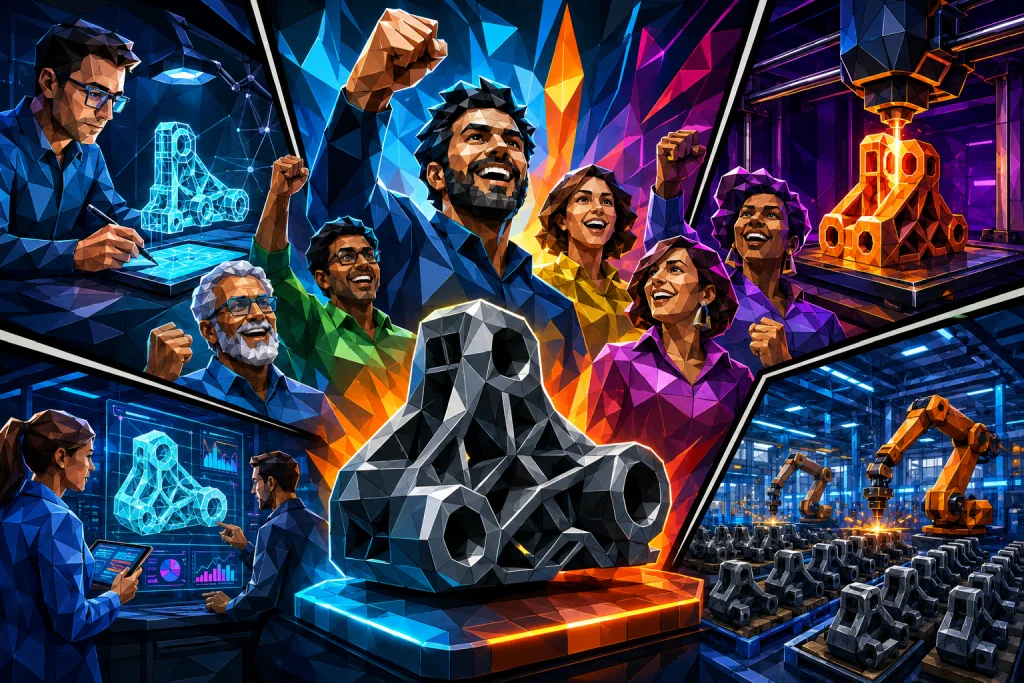
Accelerate your time-to-market with a coherent strategy from the first initial model to industrial end components in high-temperature materials
Modern product development requires speed and precision. Companies should view the journey from idea to finished product as an unbroken line rather than isolated phases. By using the same 3D print service throughout the process, you ensure unsurpassed continuity in both material selection and geometric tolerances. This approach removes the typical bottlenecks that arise when a project changes hands between different suppliers. 3D actions acts as your strategic partner, creating full security regarding both technical quality and the total 3D print time.
How is the transition from the initial prototype to a functional end component defined?
The journey toward a finished product starts with a deep understanding of the design. An initial prototype serves to test form and ergonomics, while an end component must perform under demanding industrial conditions. In this phase, companies should implement Product Lifecycle Management (PLM) to connect data and processes effectively. A structured PLM strategy creates a common thread from concept development through CAD design to the final manufacturing phase. It ensures that the experiences you gain with the first 3D printed models are transferred flawlessly to the 3D print as an end product.
Which technology should be chosen when the 3D print itself is to be the end product?
The right technology choice depends entirely on the part’s end environment and the forces it is exposed to. FDM (Fused Deposition Modeling) is today a recognized method for manufacturing robust components in high-temperature materials such as Ultem, PEEK, or PEKK. When designing for this technology, however, you must take into account that the bonding between layers in the Z-axis typically constitutes 40-70 percent of the strength in the horizontal planes. If your end product requires a flawless surface finish or extremely complex internal channels, you should instead consider technologies such as SLS or SLA. For specialized tasks within medical equipment, Polyjet technology allows for mimicking biological tissue and bone structures with a precision that was previously unattainable.
How to minimize time-to-market by skipping tool manufacturing?
You often save several months in your development process by removing the need for physical molds. This method is called tool-less production and eliminates the heavy start-up costs normally associated with injection molding. By using the 3D print itself as the final component, you go directly from an approved digital file to series production. This flexibility makes it possible to optimize your Manufacturing Bill of Materials (MBOM) continuously and react quickly to changes in the market. By settling in INR and producing with our team, you also remove the uncertainty of global supply chains and slow shipping times.
How to ensure consistent quality in series production with 3D print?
Consistent quality in an industrial series requires total control over every single variable in the process. Companies should set non-negotiable requirements for traceability throughout the production line. At 3D actions, we document the process with Certificates of Conformance (COC) and Certificates of Analysis (COA) for industries with extreme requirements such as aerospace and the medical industry. By managing the materials’ life cycle, including Powder Lifecycle Management, we ensure that every single 3D printer delivers identical results every time. This systematic approach guarantees that component number 10,000 possesses exactly the same mechanical properties as the first prototype.
Which factors affect the total 3D print time and economy when scaling?
The price and speed of production depend on your ability to use Design for Additive Manufacturing (DfAM). Small design adjustments have a major influence on the total 3D print time and thus your budget. By implementing 45-degree chamfers and fillets, you make the part both stronger and faster to manufacture for a 3D printer. For large parts, we can advantageously split them into smaller sections and subsequently assemble them with precise chemical welding or mechanical solutions. This reduces the need for support material and optimizes space in the machine, which directly lowers the costs per part.
How does in-house maintenance of the machine park ensure stable operation?
A professional 3D print service should always have full control over its equipment. Experience shows that the ability to perform advanced service and maintenance on the machine park in-house is crucial for meeting tight delivery deadlines. When you order a series production, production must never come to a standstill due to mechanical failures. By having the expertise to service everything from large SLA systems to specialized high-temperature 3D printers internally, we remove dependence on external technicians. This ensures a stable 3D print time and a guarantee that your orders are delivered on time, whether they involve standard components or complex high-temperature parts.
Which technical requirements must be clarified before the 3D print itself transitions to production?
Before production starts, it is necessary to define the exact operating environment of the part. We need to know if the component is exposed to extreme temperatures in an engine compartment or must function in a cryo-tank with liquid nitrogen. Factors such as chemical resistance to petrol, acid, or lubricating oils play a direct role in the choice of materials like PEEK or Carbon-Nylon. Similarly, we should know about any exposure to direct UV light or requirements for sterilization for medical use. The more details we have about the mechanical forces and surface requirements, the better we can optimize the production strategy for the individual 3D printer.
FAQ: The journey from prototype to production
Below you will find answers to the most central questions about how your company scales from the initial prototypes to industrial series production. We have gathered the topics our customers most frequently request insight into to ensure effective product development.
How much does industrial 3D print cost in series production?
The price is calculated in INR based on material choice, the volume of the part, and the total 3D print time. In series production, the unit price drops significantly compared to standalone prototypes. The advantage is avoiding the massive start-up costs for molds, making the technology highly competitive for small and medium-sized series of parts.
Which materials are best suited for 3D print end-use?
High-temperature materials like PEEK, Ultem, and Carbon-Nylon are the strongest choices for end-use parts in industrial environments. These materials offer extreme thermal and chemical resistance. The choice depends on the operating environment, where a 3D printer can create components that perform at a level equal to or better than traditionally manufactured plastic parts.
What is the delivery time for a 3D print service in India?
Delivery time depends on the series size, but we often deliver the first finished parts within a few working days. Because we produce locally, you avoid waiting time for shipping from abroad. An optimized 3D print time and effective post-processing ensure that your series production is ready for use extremely quickly.
How is the quality and strength of 3D printed parts ensured?
Quality is ensured through precise orientation of the part relative to the layers and the use of certified materials. By optimizing the design according to DfAM principles, strength is increased in critical zones. We provide full documentation such as COC and COA, which guarantees that every single 3D printer in the series delivers consistent results.
Can 3D print replace traditional injection molding?
Yes, 3D print should be used as an alternative to injection molding when you want to avoid mold costs and achieve geometric freedom. For small and medium-sized series, it is often cheaper and faster to produce the 3D print itself directly. This also enables on-demand production, reducing your need for stock-keeping.
Are 3D printed components water- and airtight?
As standard, FDM parts are not always completely tight, but we can optimize the process to become hydraulically stable. By adjusting how the material is laid down by the individual 3D printer, we can create parts that hold tight under high pressure. This requires specific settings that should be agreed upon before production starts.
Take control of your production with industrial 3D print today
The journey from the first lines to the finished end components requires a partner who understands both the craft and the technology. By integrating active design principles and strong management of the product’s life cycle, your company can achieve significant competitive advantages. You should not let your production be limited by the heavy processes of the past, but instead utilize the freedom and speed that modern industrial 3D print offers.
Contact us for a technical dialogue about your next series production, so together we can find the right path from idea to reality in your preferred materials.