
Engineers should use biological growth patterns and artificial intelligence to optimize the 3D print itself and reduce material consumption in production.
Industrial production is facing a necessary shift where traditional construction methods no longer deliver the necessary results. Engineers should increasingly look toward nature to find solutions to complex mechanical challenges. Bio-inspired design is not about a superficial copying of nature’s appearance. Instead, it is about abstracting the underlying principles and using biological logic to create stronger and lighter components via a professional 3D print service. This approach ensures that the 3D print itself does not just become a visual imitation, but a functional optimization that utilizes the materials to the maximum.
[3D print business]
Why bio-inspired design often fails in industrial production
Many projects within bionic design unfortunately end up as ad-hoc solutions without real industrial value. The industry today lacks software that functions as a real form-generating tool on par with the well-known CAD systems. Engineers should therefore avoid the trap of making a design complex without a precise technical purpose. At Arizona State University, teaching is limited to 30 students to ensure that they learn to operate an industrial 3D printer such as Stratasys 450mc with high precision. Companies should perceive this knowledge as a fundamental tool on par with traditional CNC machining to remain competitive.
The difference between bio-abstraction and simple copying of nature
Bio-abstraction isolates a specific biological principle and transfers it directly to engineering. A concrete example is the venus flower basket sponge, which researchers from Purdue University in Indiana have investigated thoroughly. By strategically removing connections in a lattice, one can increase the material’s compliance by 10 to 20 times. This technical method is called selective nodal decoupling. Engineers should apply this logic to control the stiffness in a component rather than simply imitating the outer geometry of the sponge. By understanding the principles behind lattice structures, one can design items that react optimally to external loads in the 3D print itself.
Geometric growth patterns optimize strength in the 3D print itself
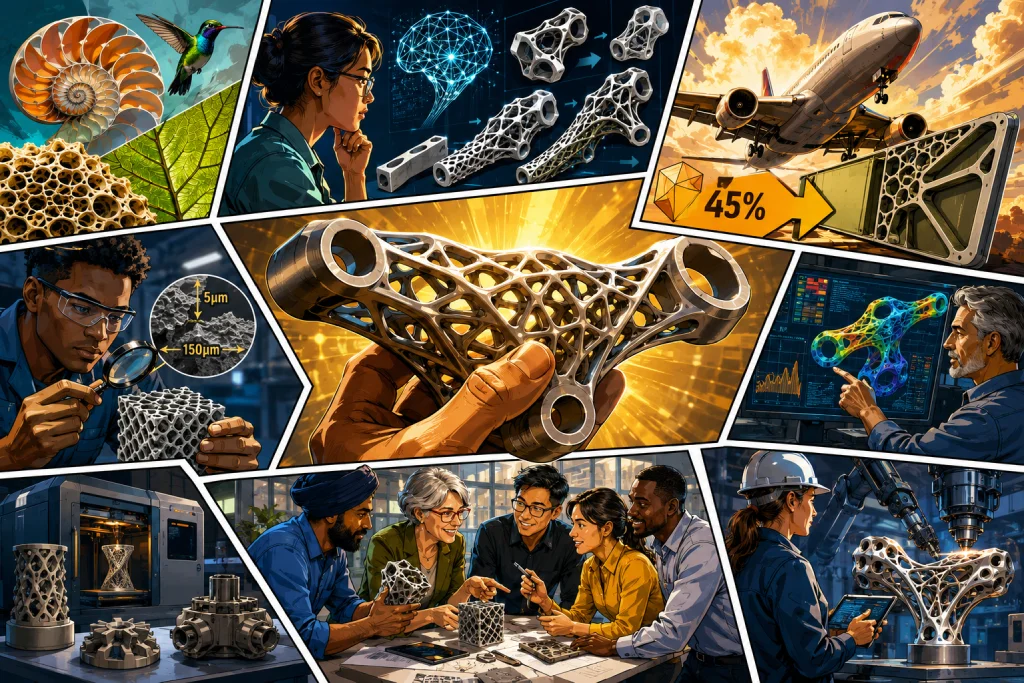
Nature uses advanced growth patterns to place material exactly where the mechanical forces are greatest. A motor shaft optimized with artificial intelligence, for example, saves 20 percent material compared to a standard cylinder. The result is a contoured shape that significantly reduces both weight and energy consumption. The aircraft manufacturer Airbus has achieved a weight saving of 45 percent on their bionic partitions by implementing similar organic algorithms. Engineers should utilize these patterns to optimize the 3D print itself for specific load scenarios, which creates a superior strength-to-weight ratio.
Design for additive manufacturing reduces material waste and 3D print time
Design for additive manufacturing (DFAM) is crucial for minimizing both material consumption and the total 3D print time. During the design phase, the designer should focus on the negative space, which are the voids that define the structure. These voids enable controlled deformation or an extremely efficient flow of liquids and gas. By using professional DFAM, the company ensures that the 3D print itself succeeds on the first attempt without the need for expensive iterations. This process reduces the total costs in INR on the bottom line, as it removes the risk of failed productions and unnecessary material waste.
Surface roughness and material fatigue are decisive for the 3D print itself
Even small microscopic details have a decisive impact on the long-term durability of the component. A slender beam in a lattice of 150 microns is violently affected by a surface roughness of just 5 microns. This relationship creates a geometric uncertainty of 10 percent, which increases the risk of unforeseen fatigue failure in the material. Engineers at our facility must always include these physical factors in their calculations of the total cost of ownership. An industrial 3D printer requires precise technical control of these parameters to deliver parts to critical industries such as medical or aviation.
AI-based surrogate models accelerate the development of complex parts
Traditional simulations often take many hours or even days to complete for complex bio-inspired items. AI-based surrogate models function as effective mathematical shortcuts that predict stress distribution and heat development almost instantaneously. This technology lets the engineer test thousands of design variations in minutes rather than waiting for slow calculations. The surrogate model functions as a digital twin that guides the design toward the most efficient form in real time. Companies should implement these digital tools to shorten their product development and optimize the 3D print itself to perfection.
Mechanical compliance creates safety in unstructured environments
Cecilia Laschi from the National University of Singapore highlights that soft robots and components need compliance to function safely alongside humans. The 3D print itself should therefore contain a form of physical intelligence, where the geometry of the material reacts to external pressure without the need for complex electronics. This principle is inspired by octopuses, which adapt their body shape to narrow passages. Designers should think this compliance into their parts to increase robustness in real life, where the environment is often unpredictable and requires flexible mechanical solutions.
The economic advantages of a professional 3D print service
Professional advice removes the technical uncertainty in the production of complex bio-inspired geometries. A service like 3D actions offers multi-objective optimization, which finds the ideal balance between production price, mechanical strength, and low weight. By outsourcing the task to specialists, companies avoid large investments in their own 3D printer, which quickly risks becoming technologically obsolete. This provides a noticeable economic advantage in INR and simultaneously ensures access to the latest knowledge about the 3D print itself and advanced materials like titanium or high-performance polymers like PEEK.
FAQ: Bio-inspired design and 3D print
Here you will find answers to the most relevant questions about how nature and technology merge in modern industrial production. We review the technical advantages of using biological logic and advanced software to optimize your mechanical components at 3D actions.
What are the biggest advantages of using bionics in the 3D print itself?
The biggest advantages are significant weight reduction and optimized material consumption in your industrial production. By imitating natural growth patterns, you achieve a higher strength-to-weight ratio than with traditional construction. A professional 3D print service can implement these complex geometries effectively, which shortens your total 3D print time and reduces costs in INR.
How does 3D printed bionic design save weight in industrial parts?
Bionic design saves weight by removing redundant material from areas without mechanical load through advanced topology optimizations. Companies like Airbus have achieved savings of 45 percent by using bionic principles in their constructions. The 3D print itself enables these organic shapes, which are impossible to manufacture with traditional methods like milling.
What does a professional 3D print service cost for complex parts?
The price for a professional 3D print service depends on the size of the item, material choice, and the complexity of the 3D print itself. By using 3D actions, you avoid large investments in your own 3D printer and gain access to multi-objective optimization. This ensures the most economical solution in INR per unit.
How does artificial intelligence improve the 3D print itself and the design process?
Artificial intelligence improves the process by using surrogate models to quickly predict stress distribution and optimal geometries. This significantly shortens the development phase and ensures a more precise 3D print time per item. AI functions as a virtual co-engineer that tests thousands of variations to find the best technical solution.
What does DfAM mean for optimization of the 3D print itself?
DfAM means design for additive manufacturing and ensures that the part is constructed specifically for an industrial 3D printer. By focusing on negative spaces and lattice structures, material waste and the need for support structures are minimized. This design strategy is crucial for achieving functional advantages and a faster 3D print time in your production.
Which materials are best suited for bio-inspired 3D print in the industry?
Materials like titanium and high-performance polymers like PEEK are ideal for bio-inspired items in critical industries. The 3D print itself in these materials enables the production of light and extremely strong components for medical or aviation. A 3D print service helps you choose the right material for your specific task.
Future-proof your production with biological logic and 3D actions
The application of biological logic in the industry leads to products that are both resilient and self-reinforcing. Today, we are moving away from static and heavy constructions toward dynamic systems that withstand unforeseen loads through intelligent design. 3D actions helps companies take the decisive step from theoretical concepts to practical reality in production. By using a professional 3D print service, you get direct access to the necessary tools and the expertise that transforms bio-inspired principles into a real competitive advantage.
You should contact 3D actions today for a dialogue on how biological logic and advanced software can optimize your next mechanical component and ensure a more efficient production.