
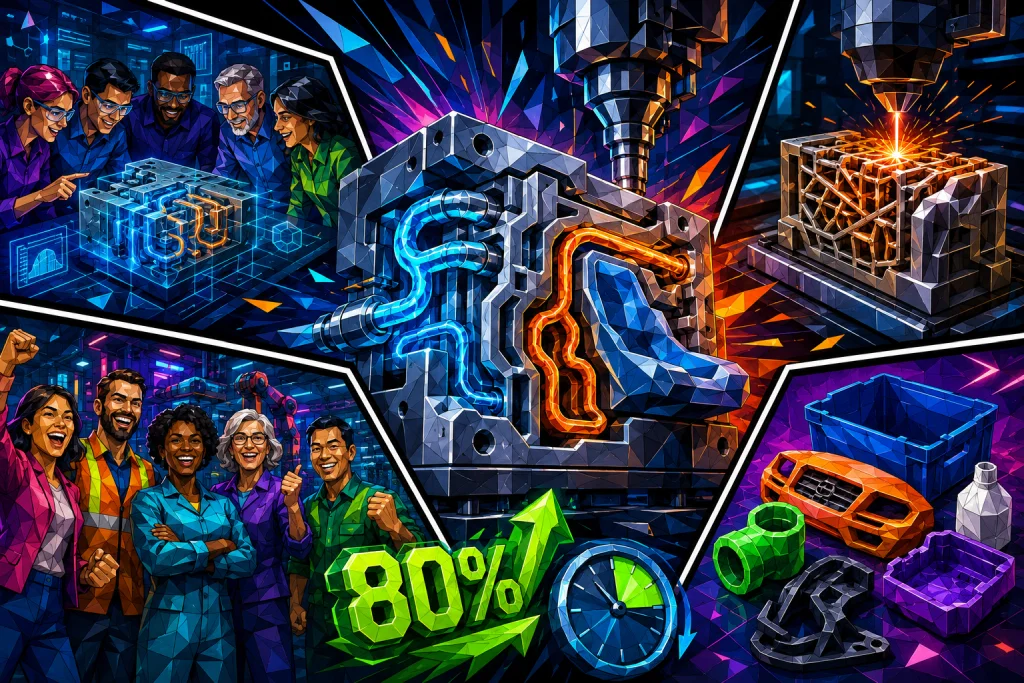
How the 3D print itself of metal inserts reduces cycle time and improves the bottom line in plastic production.
Conformal cooling describes a method where cooling channels in an injection mold follow the geometry of the part itself precisely. Where traditional cooling channels consist of drilled holes in straight lines that often leave critical areas without cooling, the 3D print itself of tool inserts makes it possible to place cooling at a constant distance from the entire surface. This technique ensures a uniform temperature distribution in the tool and removes thermal bottlenecks. The technology behind industrial 3D print in metal has existed for over 27 years and is today a thoroughly tested solution for professional tool manufacturing. Plastic manufacturers should apply this method to ensure their competitiveness in a global economy where speed and precision are decisive.
Modern plastic parts today require far higher complexity than just ten years ago. A contemporary injection mold often contains a sea of moving parts such as lifters and sliders, which makes the interior of the mold comparable to a Swiss cheese. Traditional milling and drilling limit engineers to straight lines that cannot navigate around these mechanical parts. This results in poor cooling in the most cramped areas. A 3D printer solves the problem by building the channels layer by layer around all obstacles. Cooling normally drives between 80 and 85 percent of the total cycle time in plastic molding. By optimizing this phase, companies should expect a reduction in cycle time of between 20 and 80 percent. The 3D print itself of inserts in tool steel removes heat faster so the machine opens the mold earlier. This increases production from each individual injection molding machine without the need to buy more machines.
A hot-spot occurs when heat accumulates in the tool and is not led away quickly enough. These hot areas often create warping in the part or prolong the 3D print time and cooling time in production. At 3D actions, we identify these areas with thermal cameras directly on existing molds. We then design specific inserts in tool steel with internal cooling spirals based on advanced flow and thermal simulations. In addition to heat problems, the 3D print itself also solves challenges with air pockets called gas traps. Air pockets occur when gases are trapped in the mold and create burn marks. A 3D printer can create porous structures in the steel that allow gases to escape while the plastic remains inside the mold. This technique improves the cosmetic finish and reduces waste in production significantly.
Many companies hesitate to start new projects due to the high costs of tools. Large sums are often spent on 3D printed prototypes that cannot be used in the actual series production. By choosing a 3D print service for the manufacture of real tool inserts in steel, a direct path to production is created. One should consider a fixed-price program like Supermold where you receive a steel tool with a lifetime guarantee. For parts under 50.8 mm in diameter, the first 1,000 parts cost approximately 400 INR per piece. Subsequently, the price drops to around 55 INR per piece plus material price because the customer owns the tool themselves. For larger parts up to 127 mm by 127 mm, one should expect a tool price of around 605,000 INR. This model makes it economically possible to start with low quantities and scale up to series production without wasting the initial investment.
Physical warehouses cost companies millions in tied-up capital every single month. A digital inventory at 3D actions replaces heavy storage shelves with digital files. When the need for a spare part arises, we activate production immediately. A 3D printer manufactures the necessary parts in 2 to 4 days, which removes the need for warehousing. One should digitalize a fixed part of their inventory to increase liquidity. The 3D print itself takes place in materials such as titanium or tool steel in the highest quality. The price of titanium has halved in recent years and the price of steel powder is now fully competitive with massive steel blocks for milling. The greatest economic gain, however, lies in doubling the output from your existing molds.
In the production of medical equipment, a mold with 96 cavities requires all parts to be 100 percent identical. Traditional molds often experience temperature differences between the outer and inner parts of the mold, which creates variation in quality. Through the 3D print itself of each individual core, a uniform temperature is achieved throughout the tool. This ensures uniform parts and increases the total utilization of the machine. The process starts with a thorough analysis of your STL files. We check if the resolution is correct and if the geometry fits the chosen 3D printer. We use a hybrid method where we combine traditional milling of the mold base with the 3D print itself of the complex cooling cores. All processes from analysis to heat treatment and high polishing take place in-house at 3D actions. This control ensures delivery within a few days.
FAQ: Optimization of injection molding
This overview helps you understand how modern technologies such as conformal cooling and advanced 3D print solutions can improve your production and reduce your total costs.
How much should one reduce cycle time with 3D print?
One should reduce cycle time by up to 80 percent by using conformal cooling in your tools. Since cooling constitutes the majority of the production time, the 3D print itself of optimized channels effectively removes thermal bottlenecks. This means that a 3D printer helps to double the output from your existing injection molding machine very quickly.
What does 3D printed tooling with conformal cooling cost?
The price of 3D printed tooling depends on the size of the part but often starts at 605,000 INR for larger mold inserts. By using a professional 3D print service, one can achieve a low unit price of approximately 400 INR for smaller parts. This includes a steel tool with a lifetime guarantee from 3D actions which ensures operation.
How do you remove hot-spots in an injection mold?
You remove hot-spots by designing internal cooling spirals that lead the heat away from the most critical areas. A 3D printer builds complex channels that traditional drilling cannot master. By using thermal cameras, 3D actions analyzes the mold and designs specific inserts in tool steel that ensure an optimal temperature.
Which metals should be used for 3D print of tool inserts?
One should use high-performance tool steel or titanium for the 3D print itself of industrial inserts for maximum durability. These materials ensure the necessary hardness and heat resistance in modern injection molding. The 3D print itself in these metals gives the tool a long lifespan and resistance to the high pressure in the molding machine itself.
What is the advantage of a digital inventory for injection molding?
A digital inventory removes the need for physical storage of expensive spare parts and heavy steel tools in the warehouse. By saving STL files digitally, 3D actions quickly activates a 3D printer when the need arises. This saves the company millions in tied-up capital and ensures delivery of critical components in a few days.
Why should 3D print be chosen over traditional milling?
3D print should be chosen when traditional milling cannot create the necessary cooling channels in parts with complex geometry. Where drilling only allows straight lines, a 3D printer gives full design freedom to optimize the cooling flow. This results in shorter 3D print time and much higher productivity in your injection molding production.
Future-proofing your production with industrial 3D print solutions
3D printer technology fundamentally changes how one should think about tool design and logistics. By removing geometric limitations and reducing cycle time by up to 80 percent, a faster payback on investment is achieved. The integration of a digital inventory removes storage costs and ensures an agile supply chain. You should choose a local 3D print service to ensure the necessary technical expertise and fast delivery. Contact 3D actions today to have your injection molding tools analyzed and hear how we can help optimize your production with tool steel and conformal cooling.