
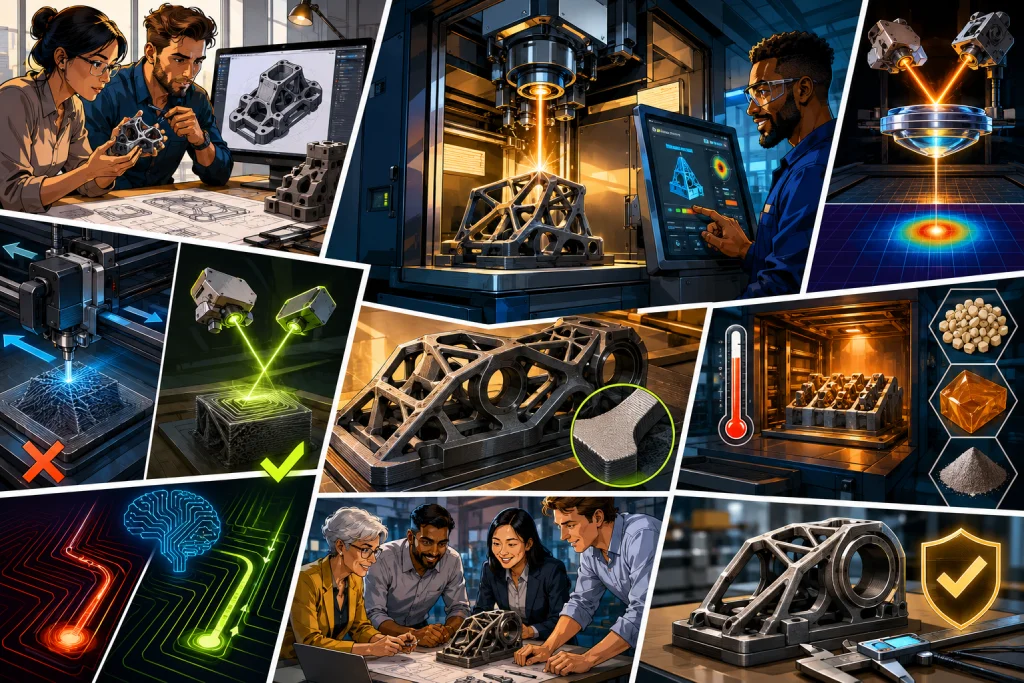
From the drawing board to the finished part – why optical hardware is vital for tolerances
Many engineers and technical buyers hesitate to implement 3D print for final production. The concern often relates to tolerances and repeatability. Can a 3D printed part comply with the same geometric requirements as a milled part? The answer depends entirely on the underlying hardware.
The difference between a hobby machine and an industrial production solution does not just lie in the price or the material. It lies deep within the machine’s optical system. This is where we separate toys from tools. To understand why professional 3D print delivers production quality, we must look closer at the technology that controls the laser.
[3D print business]
How do galvanometers differ from gantry systems?
The most fundamental difference between a desktop 3D printer and an industrial system such as SLS or SLA is the way the machine moves the energy source. Most cheaper systems utilize a gantry system. Here, the print head sits on rails and moves physically back and forth using a stepper motor.
The challenge with gantry systems is the laws of physics. The print head has mass, and when you move mass quickly, inertia occurs. This means the machine must slow down before a corner to avoid overshooting the target, which creates vibrations and inaccuracies. Precision drops drastically as speed increases.
Industrial machines, on the other hand, use galvanometer scanners. Here, the laser remains stationary while two small, ultra-light mirrors tilt and direct the light beam down onto the build plate. Since the mirrors have almost no mass, the system can accelerate extremely fast without vibrations. A good analogy is the difference between a robot arm drawing on a wall and a laser drawing patterns in the air. In a light show, a deviation of a millimeter means nothing, but in industrial material processing, that millimeter is the difference between a part that works and a part that fails. The galvanometer ensures that we can melt the material with microscopic precision, even at high speeds.
How do F-theta lenses and dynamic focus ensure a flat 3D print?
When a mirror tilts and sends a laser beam down toward a flat build plate, a natural problem arises. The distance from the mirror to the center of the plate is shorter than the distance to the corners. Without correction, the focal point would lie on a curve above the plate, resulting in blurry 3D print results at the edges. We solve this in two ways depending on the task.
For smaller and very fine tasks, a 2.5D system with an F-theta lens is often used. This optic is specially ground to force the focal point down onto a flat plane. It provides extreme sharpness but typically limits the workspace, as the physical opening of the lens is rarely larger than 20 mm.
For larger industrial parts, a static lens is not sufficient. Instead, we use a system with 3D dynamic focus. Here, an optical unit on the Z-axis moves synchronously with the mirrors. The system adjusts focus before the light hits the mirrors and actively compensates for the distance. This ensures spot uniformity, meaning the laser dot is exactly as large, round, and energy-dense in the very corner of the build chamber as it is in the center. Without this technology, the material would melt unevenly, leading to internal stresses and warped parts.
This method also increases operational reliability. In large industrial machines using powder, we avoid having expensive glass lenses located close to the powder, where they could become dirty or be affected by thermal expansion. The dynamic Z-axis sits protected higher up in the system.
Why is beam deflection crucial for geometric accuracy?
Precision in optics is ultimately about economy and risk. If you produce prototypes in cheap PLA plastic on a hobby machine, a failed print rarely matters much. In the industry, we often work with high-performance polymers like PEEK or ULTEM. These materials can easily cost 48,000 INR per kilo or more and require a heated chamber of over 90 degrees Celsius to avoid warping.
If the optics do not deliver energy precisely, or if the beam drifts over time, you do not just ruin a single 3D print. You waste expensive material and delay production. Precise beam deflection minimizes the risk of warping, as the heat input occurs in a controlled and uniform manner.
Advanced beam deflection also enables the use of technologies like acousto-optic deflectors in certain high-end systems. Here, sound waves in a crystal are used to control the light 1000 times faster than a mirror. This allows the system to paint contours with surgical precision while rapidly filling the internal content. The result is parts with sharp edges and correct dimensions that fit directly into your assembly without post-processing.
How do algorithms like scan ahead improve precision in corners?
The hardware does not do it alone. The control of the mirrors is at least as important for the quality of your 3D print. A classic problem in the process is the turn, where the laser must change direction in a corner. Without intelligent control, the laser will either burn off too much energy in the corner because it slows down, creating weak points in the material, or the machine wastes time turning on and off.
Industrial systems therefore use scan ahead algorithms. The system calculates the laser’s path milliseconds before execution. This reduces wasted time during direction changes from typically 50% down to 10% and adjusts the laser power dynamically through the turn. This ensures that a corner on your part has exactly the same strength and density as a straight surface. As a customer, you avoid spending time tuning hundreds of settings, which is typically required on cheaper machines, as we have already validated the process.
FAQ: Industrial 3D print precision
Here you will find answers to the most technical and practical questions regarding precision in professional 3D print. We dive into the differences between technologies and explain why the hardware is crucial for your final result.
What is the difference between a hobby 3D printer and an industrial machine?
The difference lies mainly in the optical system and heat management. Industrial machines use mirror-based galvanometers for extreme speed and precision, while hobby machines use heavier gantry systems with motors. This means that professional equipment delivers much sharper details and can handle advanced materials without errors.
What precision tolerances can be expected from industrial 3D print?
With professional SLS or SLA technology, one can typically achieve tolerances down to +/- 0.1 mm depending on the part’s geometry. The optical precision from the galvanometer system ensures that these dimensions are reproducible across the entire build plate every time, enabling the production of functional final parts.
How do you avoid warping in large 3D printed parts?
Warping is avoided through precise temperature control in the build chamber and uniform energy delivery via 3D dynamic focus. By keeping the temperature constantly high, especially with demanding materials, internal stresses in the plastic are minimized, so the part maintains its correct geometric shape completely after cooling.
Is the quality the same across the entire build plate for large 3D prints?
Yes, using dynamic focus and spot uniformity ensures that the laser has exactly the same power in the corners as in the center. The system actively adjusts the focal distance during the print process, so large parts do not get weak points or geometric deviations in the outer zones of the 3D print.
Why is industrial 3D print more expensive than desktop print?
The price reflects the quality of the hardware and the high operational reliability. An industrial machine uses expensive components like F-theta lenses and scanners to guarantee flawless production. You are effectively paying for the security that the part meets all specifications the first time, eliminating wasted time and expensive material losses.
Which materials require industrial optics to succeed?
High-performance materials like PEEK, ULTEM, and various metals require industrial optics to succeed. These materials are extremely sensitive to temperature fluctuations, and without precise control of the laser and heat, the parts will warp or lose their mechanical strength, making them useless.
Choose a production partner with the right technological backbone
Choosing a professional 3D print service partner is about removing uncertainty from your supply chain. While a desktop 3D printer may seem like a cheap start, it often ends up being expensive in man-hours, failed prints, and lack of precision. Maintaining a build chamber stable at high temperatures and ensuring that the optics do not deviate over time requires industrial hardware worth millions.
With our team, you get access to validated precision via optical systems that ensure tolerances across the entire build plate. You get the opportunity to use engineering materials like metal and reinforced polymers without the risk of failure, and you get scalability that ensures consistent quality, whether you order one or a thousand parts. When you order a 3D print from us, you are not just paying for the plastic. You are paying for the security that the geometry on your drawing matches the geometry in your hand.