
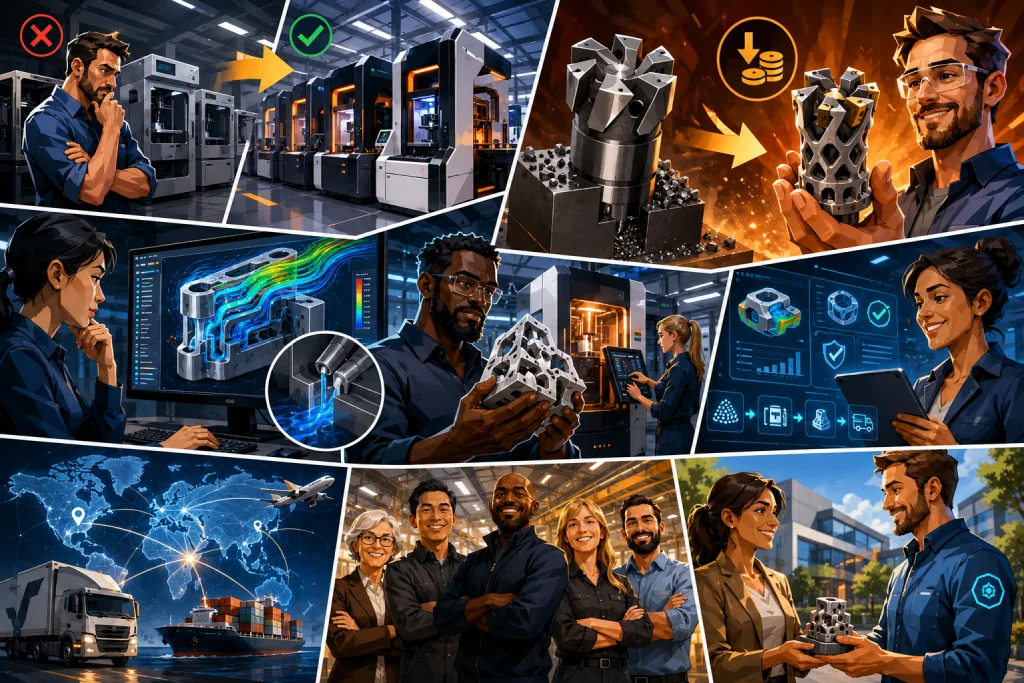
From standard machines to intelligent manufacturing: how specialization ensures better economy and higher quality.
The additive manufacturing industry is undergoing a significant change. Previously, standardized machines dominated the market with promises of being able to solve every task a company might have. That reality has changed, and we now see a clear division in the market. On one side are the mass-produced standard machines, and on the other, highly specialized production solutions are gaining ground. For you as a buyer or engineer, this development dictates both the quality and the price of your 3D print.
At 3D actions, we follow this development closely, as it directly affects how we optimize our machine park. Our goal is to deliver the most stable supply chain by exploiting exactly the advantages that specialization brings.
[3D print business]
Why is the market moving away from standardized machines?
We are currently experiencing the same maturation in the 3D print market that we know from subtractive machining. At large industrial fairs like EMO in Hannover, you no longer see only universal millers trying to do everything halfway. Instead, you see specialized production lines designed for specific items, such as battery boxes for electric vehicles or complex furniture components.
The same logic now applies to industrial 3D printer technology. The idea of “one machine for everything” belongs to the past, and hardware today must fit the application specifically to be profitable. If your production requires 10,000 items in a specific polymer, the economic solution is rarely an expensive standard machine standing idle half the time. You should instead choose a production line optimized for exactly that task.
The tool manufacturer Iscar is proof of this shift. They no longer only use 3D print for prototypes but integrate the technology directly into their series production of tools. This confirms that the market is moving from general “rapid prototyping” to a much more application-driven manufacturing where the machine serves a specific purpose.
How does specialized hardware affect the price of your 3D print?
Specialization is fundamentally about removing redundant costs. When we choose the right 3D printer for the task, you only pay for pure production capacity, not for unnecessary flexibility you won’t use anyway.
A concrete example from the industry is Iscar’s “Multi-Master” and “Quick-DMill” series. Instead of manufacturing the entire tool in solid and expensive carbide, they choose to produce the actual cutting head as a 3D print. This significantly reduces material consumption, as one avoids wasting expensive raw material on parts of the tool that do not require the same hardness. At the same time, the technology delivers a repeatability of +/- 0.02 mm. This proves that a professional 3D print matches traditional methods on both price and precision when the hardware is specialized for the task.
Process efficiency also plays a major role in the final price. Data from Boeing shows that implementing specialized production management reduced their setup time by 95% and created a return on investment of 300%. When we, as your supplier, optimize the process behind the scenes, the unit price falls directly for you because we remove wasted time and manual processes.
What role does software play in the quality of the finished item?
A 3D printer today is a software product as much as it is mechanics. The challenge has long been closed systems, so-called “black boxes,” where the operator lacked control over the process.
With modern software control and Computational Fluid Dynamics (CFD), we now design functions that were previously impossible. Iscar uses CFD to create internal cooling channels in their tools with smooth curves rather than sharp drilled angles. This removes the risk of cavitation, which is pressure loss in the fluid, and delivers coolant precisely to the cutting edge. This significantly increases the tool’s lifespan and efficiency.
Quality assurance also requires the right data. We must look beyond the concept of “Digital Twin” and focus on “The Digital Thread,” which is the common thread throughout the product’s life. It is reminiscent of statistician Abraham Wald’s analysis of aircraft during WWII. We should not only look at the errors or “bullet holes” we immediately find but understand the data we are missing. By using software for automatic “Mesh Healing” and process monitoring, we ensure your file is production-ready before the laser even starts. This minimizes errors in the 3D print itself and ensures consistent quality every time.
How is 3D print integrated into a digital supply chain?
Integration is the key to scaling. It is not just about printing an item, but about how the 3D print itself fits into a larger digital inventory. In industries like “Swiss Machining,” where precision and uptime are everything, 3D printed components are now an integrated part of operations. The ability to quickly change a 3D printed tool head without having to recalibrate the machine from scratch ensures higher uptime and thus better economy.
When you order from us, you buy access to a digital platform. We offer “Material Genealogy,” which ensures full traceability of the powder used for your item. You get a digital passport for your part documenting the journey from file to finished item.
We also offer “Connected Supply Chain,” where you as a buyer can gain insight into capacity. This removes the risk of owning machines yourself. Many companies underestimate that in-house software and maintenance often cost 50 to 60 developer-years to build from scratch. You avoid this massive cost by using a specialized partner who already has the infrastructure in place.
Why is local production an advantage for supply security?
Technology is becoming global, but supply security requires local roots. The COVID crisis exposed the vulnerability of long, global supply chains, and local production offers the necessary agility when the market changes rapidly.
By placing your order with a local supplier like 3D actions, you benefit from advanced technology without the risk of customs, long shipping times, or data leakage. We work closely with specialized machine builders, such as the German EvoBeam and the Portuguese Adira, but we anchor production in our facility. This means you get “Zero-Fail” production where we physically validate designs and ensure your items comply with local standards and metric measurements.
FAQ: Specialized 3D print
Here you will find answers to the most common questions regarding the development from standard machines to specialized industrial production. We have gathered knowledge about economy, precision, and supply chains to help you understand the value of modern 3D technology.
How does specialized hardware affect the price of a 3D print?
Specialized hardware significantly reduces the unit price by minimizing material waste and optimizing the process itself. By using a dedicated 3D printer rather than a generic machine, we remove unnecessary costs in production, giving you a lower total cost, especially for larger series sizes and demanding industrial applications.
What precision and tolerance can an industrial 3D printer deliver?
An industrial 3D printer today can deliver a repeatability down to +/- 0.02 mm on specialized items. This high precision is achieved through customized hardware and advanced software control, making it possible to match the tolerances of traditional machining, even when producing complex technical components and tools.
How do you save money on tools with 3D print?
You save expensive raw materials like carbide by only 3D printing the actual active tool head instead of the entire item. The rest of the tool can be reused, which reduces costs significantly compared to milling the entire part out of a solid block, while achieving the same wear resistance.
How does software-controlled design improve the quality of a 3D print?
Software-controlled design like CFD enables internal cooling channels with smooth curves that prevent pressure loss and cavitation in tools. This ensures that the coolant is delivered precisely to the cutting edge, which significantly increases the tool’s lifespan and efficiency—a function that is impossible to manufacture with traditional metal drilling methods.
What is the advantage of a digital supply chain in 3D print?
A digital supply chain integrates 3D print directly into your inventory management system for increased traceability and lower inventory binding. With features like Material Genealogy and digital passports, you can trace the item’s journey from powder to finished part, ensuring full documentation and removing the need to tie up capital in a physical warehouse.
Why should I choose a local 3D print supplier?
A local supplier ensures agility, supply security, and easier communication without the risk of customs or long shipping times. By choosing local production, you get a partner who physically validates designs and ensures your items comply with necessary standards, minimizing the risk of errors and delays in your delivery.
Strengthen your competitiveness through specialized production
The development is undoubtedly moving toward specialization, as standard machines can no longer compete on economy and quality at an industrial scale. You achieve a lower unit price through specialized hardware that minimizes waste of expensive materials. At the same time, you ensure consistency via software-controlled design and full data traceability throughout the product’s life. By choosing a partner with documented capacity, you also remove unnecessary risks in your supply chain.
If you want to know more about how we optimize your production with the latest technologies, you should contact us for a non-binding talk about your next project.