
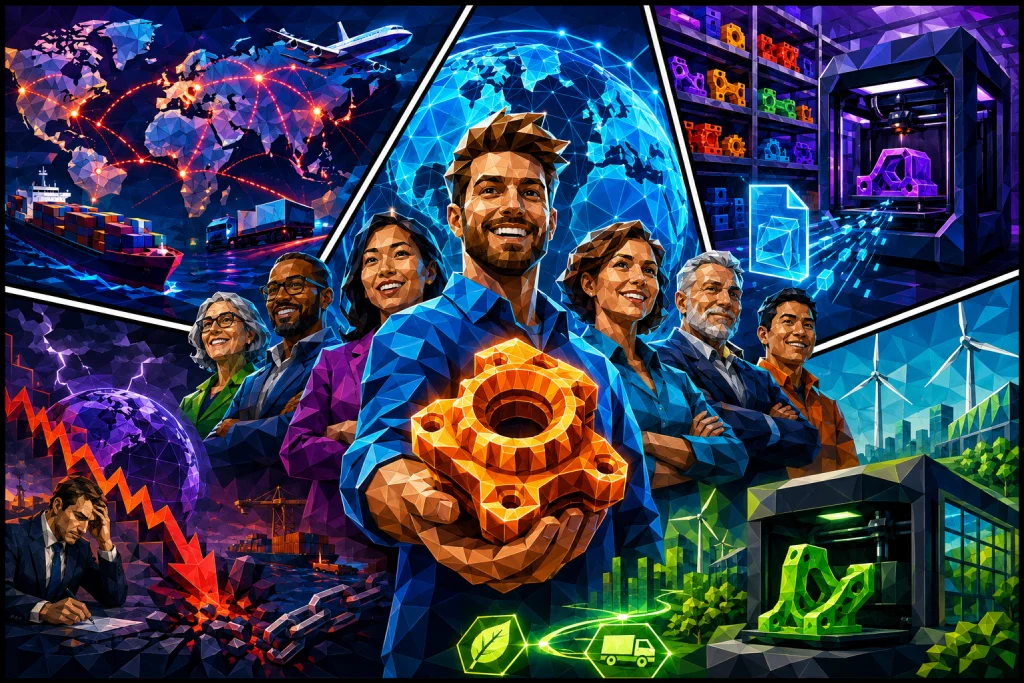
How to reduce the risk of global supply chains and free up capital with strategic 3D print.
In a traditional supply chain, raw materials often travel through nine countries and cover over 32,000 km before ending up as a finished product with the customer. Every stop on this journey adds costs, time, and risk. For industrial companies, this complex journey represents a vulnerability that modern production technology now solves.
By shifting focus from moving physical atoms to moving digital files, you change the foundation of your logistics. A 3D print service functions today as a strategic tool that shortens the supply chain significantly and increases your delivery reliability.
Why is the traditional supply chain vulnerable?
Global supply chains break more often than before. Data from the McKinsey Global Institute shows that disruptions lasting over a month now hit companies on average every 3.7 years. The consequence is seen directly on the bottom line, where analyses indicate that companies risk losing up to 45% of a year’s profit over a ten-year period due to logistical shocks alone.
When you depend on production in the Far East, you tie yourself to long delivery times and geopolitical uncertainty. A single link in the chain can stop your own production. For an operations manager, it is no longer a matter of if a disruption hits, but when it hits.
How do we minimize the journey of atoms with local 3D print?
The solution lies in the physics behind the logistics. Experts in advanced production work based on the principle of minimizing the journey of atoms. Instead of transporting raw materials and semi-finished goods around the globe, you send a digital file directly to a local 3D printer.
Recent expert analyses rank the possibility of production reallocation—the ability to quickly move production—as one of the most important factors for supply security. By utilizing a local partner, you achieve this agility. You move from a rigid, linear chain to a flexible network where the part originates close to the need. This reduces freight costs and removes customs processing from the equation.
Can a digital warehouse reduce your inventory costs?
A physical warehouse ties up capital and occupies square meters. A digital warehouse costs only server space. By converting spare parts into digital files, you free up liquidity in INR that was otherwise tied up in a safety stock.
A concrete example from the aviation industry shows the value. An adapter for signal wands was previously ordered in large batches or went missing if the supplier failed. By digitizing the part, it is now printed on-demand. The solution even allows the use of AA batteries instead of the heavier D batteries. This solves three problems at once: staff get lighter equipment, supply is guaranteed, and the need for storage space disappears.
This is supported by tool-less manufacturing. An industrial 3D printer requires no expensive molds or startup costs. This makes it economically viable to produce even small series locally, exactly when the order comes in.
What does local production mean for your carbon footprint?
Sustainability in production is about efficiency. Experts assess material efficiency as one of the primary advantages of 3D print. Traditional milling starts with a large block of metal or plastic and cuts away up to 80% as waste.
Industrial 3D print builds the part layer by layer and uses only the necessary material. This near-net-shape approach reduces waste significantly. When you combine reduced material consumption with the elimination of 32,000 km of transport, you achieve a significantly lower CO2 profile for the individual part.
How do you integrate a 3D print service into your logistics?
Integration starts before the crisis hits. Data shows that the greatest value arises through co-design. This means you involve your 3D print service early in the design phase to optimize parts for production.
Start with the obvious items. Components such as jigs, fixtures, hand tools, and brackets are perfect for digitization. Leading companies have already digitized over 5,000 item numbers in less than a year. The process requires preparation, as files must be converted and print parameters locked. Once this groundwork is in place, you simply order the item via a secure platform, and production starts immediately.
You should consider a licensing model for your own products if you wish to maintain control over your intellectual property while letting external partners handle the 3D print itself.
How are quality and traceability ensured in production?
Many engineers fear a lack of consistency when switching to new technology. Industrial 3D print counters this through full traceability. Advanced systems track the process down to the individual layer in the 3D print itself and the specific batch of raw powder.
By using digital warehouse services, production files are sent encrypted directly to the machine via IoT edge devices. This ensures that no one can alter the design and that your 3D printer uses the exact settings validated by the engineer. This removes variables from production and guarantees that the spare part has the same strength and tolerances, whether it is printed today or in five years.
FAQ: Supply chain optimization with 3D print
Here you will find answers to the most common questions about how 3D print technology can strengthen your supply chain, reduce costs, and increase delivery reliability. We have gathered insights based on data and industry experience to provide you with a quick overview.
What is a digital warehouse?
A digital warehouse is a collection of production-ready files stored virtually instead of physical products on a shelf. This makes it possible to produce spare parts on-demand via 3D print exactly when you need them. This eliminates costs for storage space, removes the risk of obsolescence, and ensures access to critical components.
Is 3D print worth it compared to traditional production?
Yes, 3D print is often worth it when considering the Total Cost of Ownership (TCO). Although the unit price may be higher, you save on expenses for molds, inventory holding, freight, and customs. For small and medium-sized series or complex parts, 3D print is often the most economical solution that also frees up liquidity in INR.
Are 3D printed parts strong enough for industrial use?
Modern industrial 3D print delivers parts with strength and tolerances that match or exceed traditionally manufactured components. We utilize advanced materials such as reinforced polymers and metals. Through full traceability and validated print parameters, we ensure consistent quality. Many industries today use 3D printed components for critical end products.
How quickly can I get a 3D print delivered?
The delivery time for 3D print is significantly shorter than traditional manufacturing, often within a few days. Since the process is tool-less, there is no waiting for the production of tools or molds. As soon as the digital file is approved, production can start. This provides an enormous advantage during machine breakdowns and minimizes expensive downtime.
How does 3D print reduce CO2 emissions?
3D print reduces CO2 emissions through less material waste and the elimination of long-distance transport. The technology builds the part layer-by-layer and uses only the necessary material, unlike milling where up to 80% is cut away. By printing locally at our facility, you also avoid the environmental impact associated with freight from, for example, Asia.
What can be produced with a 3D printer in the industry?
You can produce everything from complex spare parts and grippers to fixtures, jigs, and finished end products. The technology is ideal for parts that require great geometric freedom or customization. It is a logical action to start by digitizing production equipment and spare parts where supply security is critical. We help identify the right parts for your needs.
Make your company resilient for the future
Optimizing your supply chain today is about reducing physical dependence. By moving production to a local 3D print service, you achieve shorter delivery times, a lower carbon footprint, and freed-up capital through digital warehouses.
The technology is mature, and the economic arguments are validated by data. The question is not if you should implement 3D print in your supply chain, but which components you will start digitizing first to secure your company against future disruptions. Contact our team today for a dialogue on how we can strengthen your supply security.