
From hidden operating costs to strategic supply chains: How to navigate TCO and choose the right path between CapEx and OpEx.
Decision-makers in modern manufacturing companies often face a complex choice when assessing the value of additive manufacturing. Many mistakenly view 3D print as a simple technology for prototypes, but the real business value lies in understanding the Total Cost of Ownership (TCO). To make the right choice between investing in your own equipment (CapEx) or using an external 3D print service (OpEx), you should know the economic mechanisms that drive the price of the 3D print itself.
[3D print business]
Why machine depreciation represents a larger item than materials in an industrial 3D print service
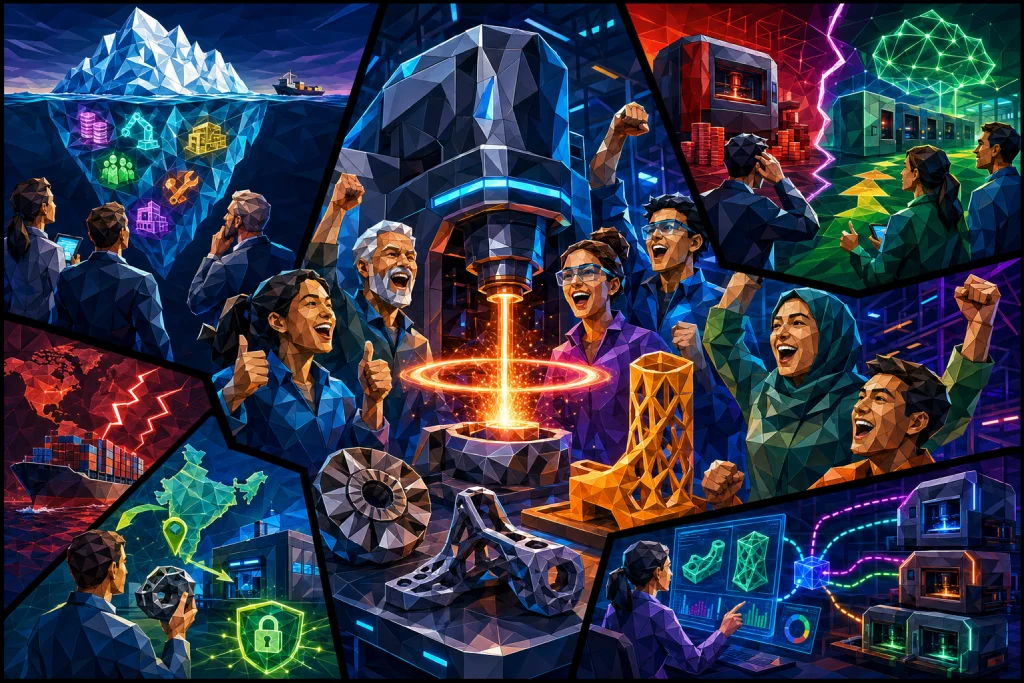
A widespread misconception in the industry is that the price of a part primarily depends on the price per kilo of the material. The truth is that materials often represent the smallest part of the total cost. You should instead consider TCO as an iceberg. The visible part above the water is the purchase price, but below the surface, you find heavy items such as depreciation on the machine, wages for operators, incoming inspection, and general and administrative (G&A) overhead costs.
Industrial 3D printers require massive investments, and they only create value when running efficiently. If you choose in-house production, you take on the entire risk of technological obsolescence and maintenance. A professional 3D print service spreads these fixed costs across many customers, which often makes it cheaper to buy access to the technology as a service rather than owning the hardware yourself.
How recoating time affects total 3D print time more than the laser itself
You should understand that an industrial 3D printer often functions as a recoating machine rather than a dedicated 3D printer. In many standard setups, the machine spends 2/3 of the time spreading new layers of powder, while the laser itself is only active for 1/3 of the total 3D print time. This phenomenon means that even a significantly faster laser does not necessarily shift the overall TCO if the machine’s mechanical movements remain the same bottleneck.
An efficient 3D print service therefore optimizes the 3D print itself by running full batches and precise schedules. This ensures that production can be completed within a standard 8-hour work shift (Monday to Friday). When comparing to traditional methods, local 3D print wins on total delivery time because you save the weeks or months it takes to have a mold machined abroad.
How the shift from 400 watt to 2 kilowatt lasers changes the economic calculation for businesses
Developments in laser technology fundamentally change what the 3D print itself costs per hour. Previously, the industry was locked into 400-watt lasers with a so-called Gaussian beam, which limited speed to avoid unstable melt pools and material spatter. New technology from nLIGHT introduces beam shaping, which enables the use of a 2-kilowatt laser with full stability.
By shaping the beam as a ring instead of a traditional bell curve, the machine distributes heat more evenly in the melt pool. This increases productivity by up to 7.8 times without compromising the part’s microstructure. For a production company, this means the required 3D print time becomes significantly shorter, lowering the unit price and making 3D print competitive at much higher volumes than before.
Why technical uptime and local expertise ensure a lower TCO in 3D print
Technical uptime is crucial for a healthy business case. Experience from large research environments shows that dependence on technicians from abroad ruins the economy. If you have to pay for a technician flying in from Germany on business class every time a 3D printer fails, your TCO in 3D print rises uncontrollably.
A local 3D print service possesses the necessary expertise to perform maintenance and repairs internally. This ensures high operational stability and removes the risk of long production stops. You should choose a partner with a deep understanding of the machine’s hardware so your parts are always delivered on time without hidden fees for downtime or technical assistance.
When volume dictates the choice between injection molding and industrial 3D print
Price often becomes the central question when production needs to scale. For a series of 1,000 parts, industrial 3D print typically costs around 3,500 INR in total costs. In comparison, traditional injection molding often costs over 28,000 INR for the same series, primarily because you must pay at least 21,000 INR just to have the mold tool manufactured.
Industrial 3D print is therefore the most economically sensible path for most companies at volumes up to 10,000 units. Modern materials like Black Resin offer strength properties similar to PET, making them suitable for final products. You should always validate durability through cyclic tests, just as you would with traditionally manufactured parts, to ensure that the 3D print itself lives up to mechanical requirements.
Why reshoring to a local 3D print service protects your business against geopolitical uncertainty
Global sourcing entails risks in the form of tariffs, trade conflicts, and uncertain logistics. When your goods are in a container in the South China Sea, you tie up capital in goods that you cannot use or sell. Reshoring production to a local 3D print service removes these invisible costs and reduces your need for pipeline inventory.
Local production also protects your intellectual property (IP), as your drawings do not leave the country. You avoid language barriers and time zone issues, making communication much more effective. By producing locally, you create an agile supply chain that can react quickly to market changes rather than being locked into large batch sizes from the Far East.
How software and 3D actions function as the overlooked factor in the price of the 3D print itself
Software and data management are the least explored tools for TCO optimization. Modern systems can now automatically reallocate tasks between multiple lasers if one needs service mid-run. This prevents failed prints and direct waste of expensive powder. A professional 3D print service uses advanced software solutions for powder management, minimizing the risk of quality failures and costly part recalls.
Through correct 3D actions and digital process management, production can run 24/7 with minimal manual intervention. You should consider software as the glue that binds hardware and economics together. Efficient digital management ensures that the economic calculation holds up in reality and that you always get the best price per part without compromising precision.
FAQ: Industrial 3D print economy
Here you will find answers to the most critical questions about costs and strategy, so you can assess the real value of the technology for your business and make a confident decision.
Is 3D print cheaper than injection molding for small series?
Yes, 3D print is significantly cheaper when producing small and medium-sized series under 10,000 units. You save the large expense of injection molding tools, which often cost over 21,000 INR. This makes the technology ideal for on-demand production, where you only pay for the parts you actually need here and now.
How do you calculate the total TCO in 3D print?
You calculate your TCO in 3D print by adding the purchase price, machine depreciation, operator time, and maintenance. You should also include indirect costs for quality control and inventory holding. Often, the price of the 3D print itself is only a small part of the total costs when you include all hidden operating expenses.
Why does 3D print time play such a large role in the price?
The total 3D print time dictates the price, as it determines the machine’s daily production. Since machine depreciation is a fixed cost, the unit price increases if the process is slow. You should see modern 2-kilowatt lasers as the solution, as they reduce this time significantly and ensure a lower price per unit in your production.
Can you achieve the same strength with 3D print as with traditional methods?
Yes, modern industrial materials like Black Resin deliver strength properties that fully match injection-molded PET. However, you should always validate the mechanical properties through cyclic tests of the 3D print itself. By optimizing the design for additive manufacturing, you should often achieve a strength that surpasses traditional components.
What is the advantage of using a local 3D print service?
A local partner ensures fast delivery and eliminates the risk of long-term pipeline inventory from abroad. You avoid geopolitical uncertainty and tariffs while your intellectual property remains protected. Local expertise also means that errors in the 3D print itself should be corrected immediately without expensive delays.
How do software and 3D actions affect the final production price?
Software optimizes your 3D actions by controlling the laser most efficiently and significantly reducing material waste. This lowers the price of the 3D print itself, as the machine is utilized to its maximum in every run. You should use software for real-time monitoring, as it minimizes the risk of costly production errors and ensures a cheaper final product.
Ensure growth and resilient supply chains with a strategic 3D print partner
The economic reality is that industrial 3D print production is about much more than just owning a machine. You should assess the total costs throughout the product’s entire lifespan and choose a model that supports your company’s cash-to-cash cycle. By switching from a vulnerable purchasing model to a flexible 3D print strategy, your company achieves a significant competitive advantage in a market characterized by change.
You should choose your partner based on technical insight, local presence, and the ability to deliver high quality on-demand. In this way, the technology becomes not just an expense for prototypes, but a strategic driving force for your company’s future growth and supply security. Contact us today to get a concrete analysis of your parts and find out how to optimize your production with industrial 3D print.