
From digital inventory to reduced waste: How additive manufacturing strengthens your green profile
The industry is in the middle of a necessary shift toward more responsible production. Companies are now critically evaluating their supply chains and manufacturing methods to meet stricter climate requirements. Here, additive manufacturing marks itself as a technically superior alternative to conventional methods. We review the concrete data and mechanisms that make the technology a rational choice for both the bottom line and the environment.
Additive manufacturing reduces material waste significantly
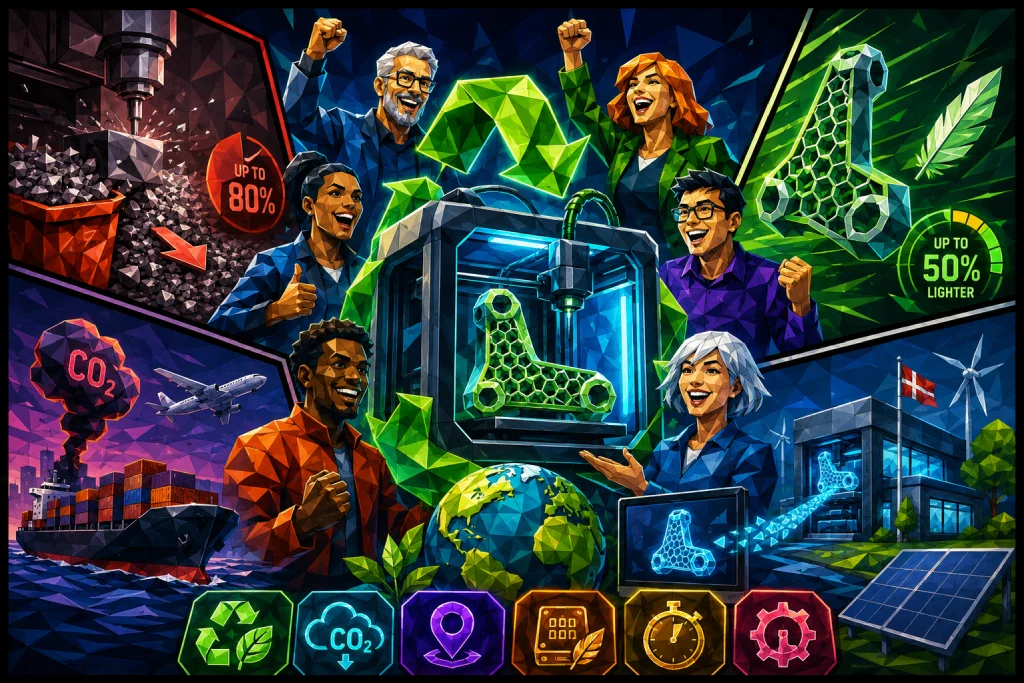
The difference between traditional machining and additive manufacturing is fundamental. In CNC milling, which is a subtractive process, the operator starts with a solid block of material. Often, up to 80% of the material is milled away to reach the finished part. This waste ends up as chips that require additional energy to dispose of or remelt.
A 3D printer, on the other hand, builds the part layer by layer. The machine exclusively uses the material that the finished design requires. Estimates suggest that the shift from subtractive to additive production reduces material waste by up to 90%. The only waste in the process is any support structures that hold the part during production. Even here, the technology is efficient, as the machine only uses energy to melt the precise amount of plastic the task requires.
This also eliminates the energy-intensive auxiliary processes known from, for example, injection molding. Here, the manufacturing of the steel mold itself costs large amounts of energy and raw materials before the first part even leaves the machine. With 3D print, we go directly from a digital file to the finished part.
Weight reduction lowers CO2 consumption during operation
Sustainability does not stop when the part leaves our 3D printer. The greatest gain often lies in the lifespan of the part. Because 3D print technology is not limited by production requirements such as draft angles in a mold, engineers can design the part with full focus on mechanical performance.
We apply methods such as topology optimization and internal lattice structures. This enables us to manufacture parts that weigh up to 50% less than equivalent solid parts, without compromising on strength. This weight reduction creates a positive effect throughout the value chain. Lighter components require less fuel to transport. If the component is part of a vehicle, an aircraft, or a moving machine, the lower weight reduces energy consumption throughout the machine’s entire lifespan.
Biodegradable materials and recycling in the industry
The choice of material is crucial for the climate footprint. Many industrial 3D print tasks are solved today with thermoplastics such as PA12 or PLA. PLA distinguishes itself by being based on plant resources like corn starch rather than crude oil. Plants absorb CO2 during growth, giving the raw material an advantageous start in its life cycle assessment. This makes the material a strong choice for prototypes and visual models.
For technical end products, we often use PA12. Here, suppliers like Evonik work actively to lower the CO2 footprint by using renewable energy and biogas in the manufacturing of the powder itself. A major advantage of thermoplastics over thermosets is recyclability. Excess powder from a run is mixed with new powder for the next 3D print, and worn parts can be shredded and recycled, as the chemical bonds allow for remelting.
Local production in Denmark minimizes transport
Transport is often the hidden culprit in the climate assessment. A study of shoe production shows that with traditional manufacturing in China, transport accounts for between 30% and 35% of the product’s total emissions.
By moving production to our team via a local service partner, the equation changes significantly. Instead of moving physical goods by plane or container ship from Asia, a digital file is sent. Production takes place at our facility, close to the point of consumption. In the example of the shoes, the transport share of emissions drops to approximately 5%. Researchers from Delft University estimate that this decentralization of production globally reduces energy consumption by between 5% and 27%.
A digital inventory removes energy waste in storage
An overlooked aspect of sustainability is building operations. Traditional supply chains require companies to produce large batches for stock to keep the unit price down. These goods must be stored in large warehouses that require heating, lighting, and moisture control. This is often the case for decades regarding spare parts.
With 3D print, the company transitions to a digital inventory. Your shelves are hard drives, and we only produce the item when the order comes in. This eliminates the need to heat thousands of square meters of concrete hall for storing goods that might never be sold. It removes the risk of overproduction, as seen in the eyewear industry, for example, where large quantities of unsold goods are discarded annually.
On-demand spare parts extend product lifespan
We support a circular economy through the possibility of repair. Often, large, well-functioning machines or appliances are discarded simply because a single small plastic component is broken, and the spare part is discontinued or has month-long delivery times.
By 3D printing the single defective component on-demand, we extend the lifespan of the overall product. It is far more sustainable to replace a gear of 50 grams than to scrap a machine of 50 kilos. It makes technical sense, and it saves resources.
Data for traditional vs. additive production
The table below compares the effect of the two production forms on key parameters for sustainability.
| Parameter | Traditional (Milling/Casting) | Additive (3D Print) |
| Material waste | High (up to 80% milled away) | Minimal (only support structure) |
| Energy consumption (Storage) | High (physical storage requires heat/light) | Low (digital inventory) |
| Transport | Global (long distance from factory to warehouse) | Local (produced at our facility) |
| Overproduction | 15-25% buffer production | 0% (produced only upon order) |
| Repair | Often replacement of modules/units | Replacement of individual parts |
FAQ: 3D print sustainable production
We receive many questions about whether it pays off to think of 3D print as part of a green strategy. Here we have gathered the most important answers explaining the environmental benefits of the technology, the materials, and the local supply chain.
How does 3D print reduce waste compared to milling?
3D print reduces material waste by up to 90% compared to traditional machining. In CNC milling, material is removed from a solid block, while a 3D printer builds the part layer by layer. The only waste is any support structures, making the method far more resource-efficient for both prototypes and end products.
Which sustainable materials can be 3D printed?
We offer biodegradable materials like PLA, which is based on plant resources like corn starch. For industrial parts, we often use thermoplastics like PA12, where the production of the powder is optimized with renewable energy. Thermoplastic can also be recycled effectively, as the material can be shredded and remelted into new products without losing its chemical properties.
How does local production lower the CO2 footprint?
Local production at our facility removes the need for energy-intensive long-distance freight from Asia. Studies show that transport can account for up to 35% of a product’s emissions in remote production. By sending a digital file for production at our headquarters, this share is reduced to approximately 5%, saving large amounts of CO2 on the bottom line.
What is the advantage of a digital inventory?
A digital inventory means that you store files rather than physical products. This eliminates the energy consumption for heating and operating large warehouses that must keep goods dry for years. We only produce the part when you order it, which removes the risk of overproduction and waste of goods that are never sold.
Can spare parts be 3D printed to avoid disposal?
Yes, 3D print is ideal for manufacturing spare parts on-demand, extending the life of your equipment. Instead of discarding an entire machine due to a defective plastic part, we can print the component locally. This saves resources and ensures you are quickly up and running again without long delivery times for parts.
How does weight reduction save energy?
By designing specifically for 3D print, we can reduce a part’s weight by up to 50% using internal lattice structures. Lighter parts require less energy to produce and less fuel to transport. This lowers the total energy consumption throughout the product’s entire lifespan, especially if the component is used in aircraft or cars.
Optimize your production with green consideration
The choice of 3D print is a strategic decision that benefits both the climate and the business. You move from a subtractive process with large material loss to an additive process that utilizes the raw material optimally. Local production at our facility removes heavy transport from the assessment and enables lighter, energy-optimized designs. At the same time, you avoid inventory binding as you only produce what you need.
Contact us for a dialogue on how we can optimize your next production with a focus on sustainability and quality.