
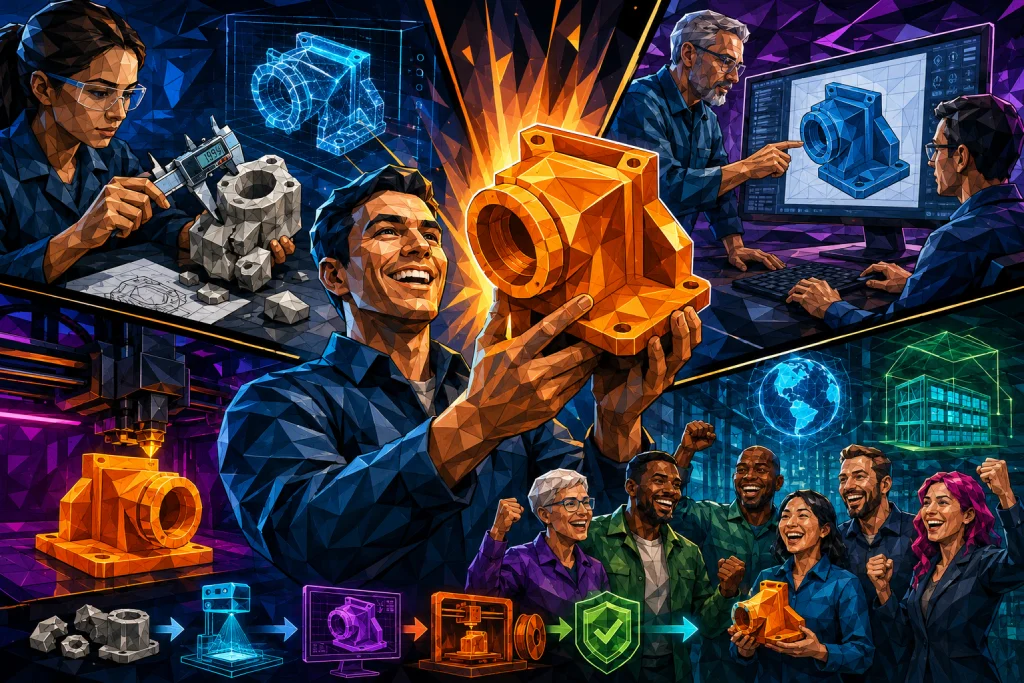
From discontinued item to new production: We recreate critical components digitally and secure your operations against unforeseen breakdowns
Many production companies know the situation. A functional machine stands still because a single plastic component has broken. The manufacturer has stopped support, the spare part is discontinued, and the conventional solution often points toward scrapping the entire machine or paying large sums for custom manufacturing.
We offer an effective alternative. Through reverse engineering and industrial 3D print, we recreate defective spare parts directly from a physical sample or a drawing. This extends the lifespan of your production equipment, reduces waste, and secures your operations.
What do you do when spare parts are discontinued by the manufacturer?
You are left with a machine that isn’t running. It could be critical equipment, such as a ventilation device for veterinary surgery, where a small air intake nozzle has broken. Without this part, the device is useless. Instead of accepting downtime or investing in entirely new equipment, you should consider on-demand production.
We take the defective part as our starting point. Even if it is broken into several pieces, or if you only have a rough sketch, it serves as our starting signal. We analyze the part’s function and the requirements it must meet during operation and recreate it digitally. This is not just about repair; it is a strategic decision to maintain the value of your existing assets.
How does the process from physical part to 3D print work?
The process starts at the workbench with precision tools. We use a digital caliper to map the part’s dimensions down to the smallest detail. We measure wall thickness—for example, 2.4 mm—and note all critical widths and heights.
Here, we use our experience to interpret the numbers. If the caliper shows 9.94 mm on a worn part, we know the original engineer likely designed the hole to be exactly 10.00 mm. We therefore round the measurements up or down to the nearest logical standard dimension. Once we have the physical dimensions, we build a digital 3D model in our CAD software. We often start with a rough sketch on paper to get an overview of the geometry before drawing it cleanly digitally. This ensures that we catch all functional details before we start our 3D printer.
Many ask about the term reverse engineering. It covers precisely this process, where we go backward from a finished product to the original drawing so we can produce a new one.
Is it necessary to change the design before 3D print?
Yes, it is often an advantage. Copying an injection-molded part 1:1 is rarely the best solution, as production methods differ. We optimize the design for the 3D print process to ensure better strength and finish.
We remove elements that only existed for the sake of the mold, such as unnecessary draft angles or “lips”. Instead, we add reinforcements. If the original had sharp edges that cut into cables or fabric, we add a rounding (a so-called fillet of e.g. 0.4 mm) into the design. This extends the lifespan of the parts the component interacts with.
We also analyze threads closely. A common mistake is to assume standard dimensions. If a thread measures close to 1 mm in pitch, we check if it is actually 1.75 mm, as even small deviations make the part useless. We also orient the part optimally during the 3D print itself—typically by rotating it 30 degrees or printing it upside down. This minimizes the need for overhangs, which are areas that stick out without support, and ensures a smoother surface without marks from support structures.
What is a digital warehouse, and why does it save money?
A digital warehouse replaces physical shelves with a hard drive. Instead of tying up capital in boxes of spare parts that might never be used, you store the files with us. When you need a part, we find the file and start our 3D printer. This is called Just-in-Time production. It eliminates the risk of obsolescence and frees up space in your warehouse.
The difference is significant. A physical warehouse requires shelving, square meters, and ties up capital in minimum orders. A digital warehouse requires no physical space, has low startup costs for design or scanning, and the delivery time is typically only 1-3 days, corresponding to the time it takes to print the part. Furthermore, it is easy to update the file if needs change, which is impossible with a box of pre-molded parts.
Can a 3D print withstand the same as the original part?
A correctly executed 3D print often matches or exceeds the original in strength. We choose material specifically according to your application. For outdoor brackets, e.g., for a pavilion or machines that stand outside, we use ASA or ABS. These materials resist UV light, rain, and high temperatures without becoming brittle or warping.
We also control the part’s internal structure. Where a molded plastic part is often hollow or has thin walls to save plastic, we can print the spare part with a high infill percentage. This means we fill the part with material internally, for example, 75% or 100% solid plastic. This provides an extremely robust component. In cases involving pneumatics or ventilation equipment, we ensure tightness by printing with a thick outer shell so the part remains airtight even under pressure of e.g. 0.3 Pascal.
How does your company get started with on-demand production?
Do you have a machine missing a part? Send the defective component or a drawing to us. We will review the task and provide you with a fixed quote in INR within a short time. We assess whether the part is suitable for 3D print and which material ensures the best operational reliability. After your approval, we start production, and you typically receive the finished spare part a few days later.
How strong is a 3D print compared to original parts?
An industrial 3D print can often be made stronger than the original part by increasing the internal density. We can print the part as solid plastic with 100% infill and use technical materials like nylon or carbon fiber, resulting in an extremely robust spare part that withstands heavy industrial loads.
What do I do if I don’t have a drawing of the spare part?
You don’t need a drawing, as we can create a new file directly from the physical component. You simply send the defective or broken part to us, and we measure it precisely with digital tools and recreate it in our CAD software so it is ready for production.
Is it cheaper to 3D print spare parts than to buy new ones?
It is often a large economic advantage, especially when the alternative is to scrap an entire machine or pay for expensive special tools. Although there is a one-time cost for the drawing, you save money in the long run by eliminating storage costs and only paying for the 3D print itself when the need arises.
Can 3D printed spare parts withstand outdoor use and heat?
Yes, we print in UV-stable materials like ASA, created specifically to withstand wind, weather, and sunlight. Unlike standard plastic that can become brittle outdoors, our industrial material selection ensures that brackets and components maintain their strength and dimensional stability even under demanding weather conditions.
What is a digital warehouse, and how does it save money?
A digital warehouse means we store your spare parts as files on a server instead of as physical goods on a shelf. This frees up capital as you don’t have to tie up money in minimum orders, and you save on space costs while being guaranteed lightning-fast delivery in case of breakdown.
How fast can you deliver a 3D printed spare part?
We typically have a production time of a few days from when the 3D file is approved to dispatch. If we first need to draw the part via reverse engineering, the process takes slightly longer, but once the part is in the digital warehouse, we can often produce and deliver new items within 1-3 business days.
Future-proof your machine park with digital production
If you want to avoid scrapping functional machines due to small defects, digital production is the answer. By converting physical spare parts into digital files, you secure your supply chain against discontinued items. You get access to strong materials, design optimization, and a production partner that understands the importance of uptime. It is common sense for both the economy and sustainability.