
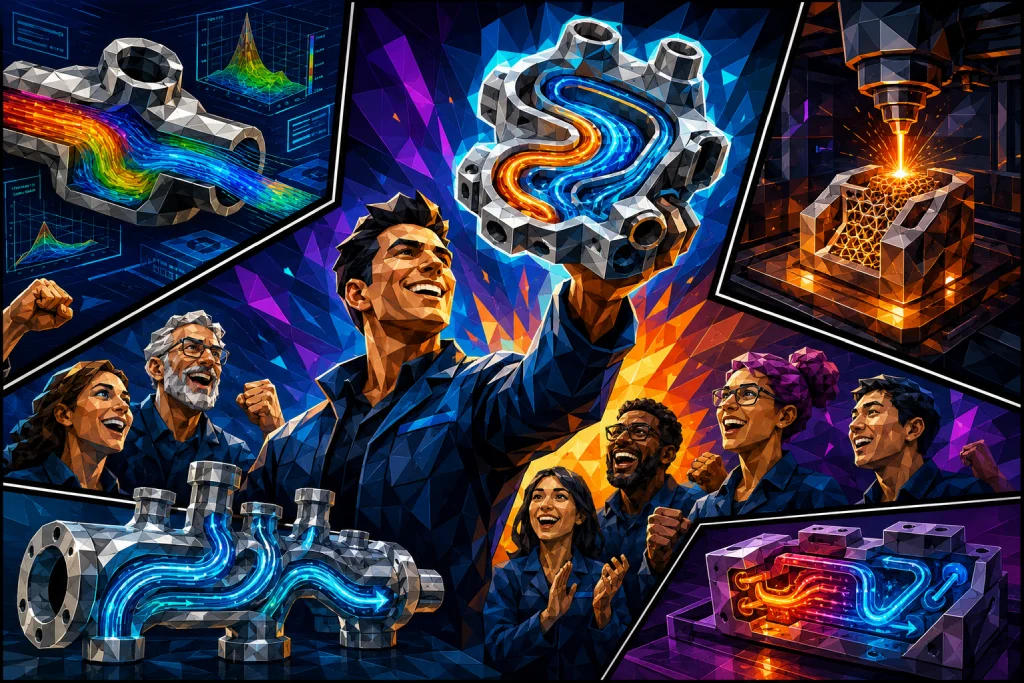
From weight reduction to advanced physics: Increase machine efficiency through thermodynamic design
Lightweight design often dominates the conversation about additive manufacturing. Engineers remove material to save weight. However, the real economic gain lies elsewhere. The value arises when you improve the physics of the part through thermodynamics and fluid dynamics.
Efficiency in engines and machines depends on the temperature difference, known as Delta T. The higher the temperature difference you control, the higher the efficiency the system achieves. Traditional production methods limit your options for placing cooling exactly where the heat occurs. Industrial 3D print removes these limitations. It is no longer just about printing complex shapes. It is about putting technology into action to reduce pressure loss, increase cooling effects, and improve your OEE (Overall Equipment Effectiveness).
From FEA to CFD: How do we change the design process?
Many engineers validate designs via FEA (Finite Element Analysis) to ensure structural strength. The shift to 3D print requires a new mindset. Focus moves to CFD (Computational Fluid Dynamics), which simulates liquids and gases.
A weight reduction of 20 grams rarely changes a business case. A reduction in pressure loss of 20 percent via CFD optimization, however, significantly extends the life of the pump or motor. This changes the economy of the entire system. The design process shifts from removing material to shaping the flow.
Moderne software like Siemens NX automates this process at our facility. Where the engineer previously spent days manually drawing cooling channels, the software now handles it in minutes. Using techniques like the projection method, the software casts the cooling channels directly onto the contours of the part. The intersection method automatically connects inlets and outlets. The design is dictated by the flow requirements, not by what a drill can achieve.
Which applications achieve the greatest gain?
The industry sees tangible benefits from optimizing physics in three specific categories where traditional methods fall short.
Manifolds often suffer from right angles caused by drilling in traditional manufacturing. This creates turbulence and pressure loss. A 3D printed manifold features smooth curves that guide the fluid efficiently without resistance. We optimize the volume of liquid or gas precisely for the application, which significantly reduces the energy consumption of the pumps in the system.
Heat exchangers and suppressors require maximum surface area within a limited volume. A 3D printer builds complex internal lattice structures that traditional CNC could never produce. This increases thermal transfer.
Cooling channels for injection molding represent the most widespread application. In the plastics industry, every second counts. Conformal cooling, where the channels follow the surface of the mold, ensures uniform cooling. This minimizes thermal deformation in the finished plastic part. Most importantly, it reduces cycle time. If you cool the mold down faster, you produce more parts per hour. This is the action that separates the major players from the amateurs.
Can traditional manufacturing keep up with development?
Traditional manufacturing attempts to keep up with development. We see solutions with bent metal and complex soldering to mimic the geometries we create with 3D print. However, a critical problem arises here. Joints leak.
For hydraulic components and heat exchangers, tightness is paramount. When you solder complex cores together, you introduce a risk of errors and leaks. An industrial 3D printer produces the part as one consolidated unit without joints. This eliminates the risk of internal leaks.
Previously, engineers solved heat problems by using expensive, exotic materials like ceramics. With 3D print, we solve the problem through geometry instead. We use active cooling in standard tool steel to achieve the same or better results. This lowers material costs significantly.
Why does this require a professional 3D print service?
Companies often experiment with desktop 3D printers, but for flow-critical parts, this poses a risk. Desktop-printed parts often have porosity that allows liquid to seep through under pressure.
A professional 3D print service delivers fully dense metal parts, typically with over 99.5% density. However, the machine is only half the solution. The greatest risk is economic. A failed full-scale print can quickly cost over 1,200,000 INR in lost material and machine time.
Therefore, the process requires validation. We do not just print a file. We analyze it. Professional operators use simulation tools to predict thermal stresses and flow properties before the print starts. This ensures that you receive a part that works the first time.
Data comparison: how does 3D print win on the numbers?
The table below compares traditional CNC machining with industrial 3D print (LPBF) regarding thermal and hydraulic properties.
| Parameter | Traditional CNC / Drilling | Industrial 3D print (LPBF) |
| Design freedom | Low (limited by tool access) | High (only limited by physics) |
| Pressure loss | High (sharp 90-degree angles) | Low (organic, smooth curves) |
| Cooling efficiency | Medium (linear channels) | High (conformal channels near the surface) |
| Risk of leakage | High (at joints/solder points) | Low (monolithic construction) |
| Production speed (Design) | Days to weeks (manual layout) | Hours to minutes (software-generated) |
FAQ: Industrial 3D print and flow optimization
Here you will find answers to the most common questions regarding the use of additive manufacturing for technical and thermal applications, so you can assess the potential for your business.
What is conformal cooling in injection molding?
Conformal cooling consists of cooling channels that follow the shape of the part precisely to ensure fast and uniform cooling in the mold tool. This significantly reduces cycle time in production and minimizes the risk of warping in plastic parts. The technique requires an industrial 3D printer, as traditional drills cannot create curved channels.
Are 3D printed parts leak-proof against liquid and pressure?
Yes, professionally manufactured metal parts are fully dense and leak-free with a density typically over 99.5%. We print the parts as one single unit without joints or soldering, which eliminates the risk of leaks that often occur with traditionally assembled hydraulic components and heat exchangers.
What is the difference between CNC and 3D print for flow components?
3D print allows for organic curves and internal structures, whereas CNC is limited by tool access and often creates sharp angles. The organic shapes in a 3D printed part significantly reduce turbulence and pressure loss, providing higher energy efficiency compared to the straight, drilled channels in CNC-machined parts.
Which materials can be used for heat exchangers and manifolds?
We most often use stainless steel, aluminum, or tool steel depending on your requirements for thermal conductivity and corrosion resistance. Industrial 3D print in metal ensures that the mechanical properties of the material match or exceed traditionally manufactured metals, so you can safely use them in demanding industrial environments with high temperatures.
Can you 3D print spare parts for existing machines?
Yes, it is possible to recreate and optimize spare parts that can no longer be obtained from the original supplier. Our team can often improve the old part by optimizing the design for better flow or cooling, which not only keeps the machine running but also extends its lifespan and efficiency.
What does it cost to 3D print a flow-optimized part?
The price depends on the volume, material, and complexity of the part, but the real savings usually lie in improved operation. The 3D print itself may be more expensive to purchase than a standard part, but the money is quickly earned back through reduced energy consumption, faster cycle times, or fewer expensive machine stops.
Are you ready to challenge the limits of physics?
Lightweight has its place, but flow and thermal control create long-term value. The industry is moving away from simple prototypes toward high-performance end components. If you are struggling with overheating, long cycle times in the molding process, or high energy consumption in your pumps, you should consider additive manufacturing.
Send us your STEP file for a non-binding flow assessment. We will investigate whether your design contains potential for improvement that pays off on the bottom line.