
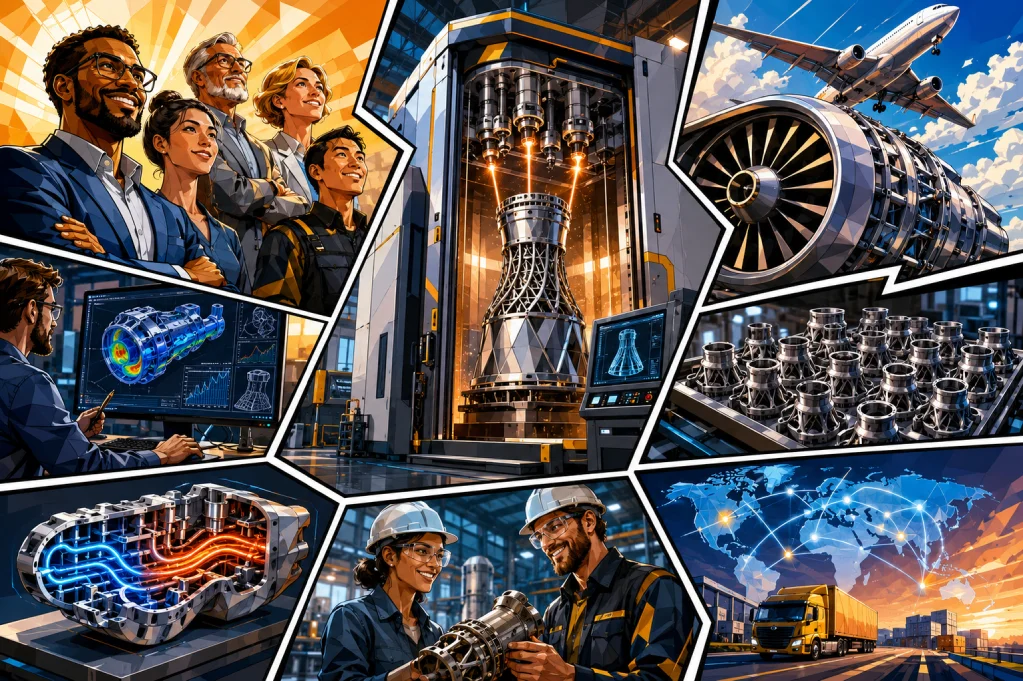
Companies are scaling production and reducing CapEx through advanced material science and digital integration.
Modern machines function today as real production facilities and are no longer reserved for the manufacturing of prototypes. This development means that companies now use a professional 3D print service to scale their production without tying up capital in expensive equipment. A review of the technological journey from the first steps in 1989 to today’s 1.5-meter-high machines shows how the industry can now 3D print complex items in one combined part.
The development from fragile prototypes to industrial strength
The journey toward modern metal production started in 1989 with the first attempts within stereolithography. Back then, the results were often brittle and broke under the slightest load. The turning point occurred in 1995 at Fraunhofer ILT in Aachen, where researchers like Wilhelm Meiners laid the foundation for Selective Laser Melting. In 1998, the first automated machine hit the market, marking the transition from manual laboratory experiments to industrial facilities. Since then, the technology has matured to a point where the 3D print itself possesses a structural integrity that surpasses traditional manufacturing methods in critical sectors.
Scaling production without heavy investments
Companies should avoid the massive investments in their own machinery, which often drain liquidity. An industrial 3D printer requires not just capital, but also an extensive IT infrastructure for simulation and monitoring. By outsourcing production to a 3D print service, you remove the financial risk and ensure access to the latest technology. An external partner guarantees a stable 3D print time and possesses specialized knowledge on how to handle complex metal powders. This gives smaller companies the opportunity to compete on equal terms with global players, as they exclusively pay for the finished items.
The potential of the new 1.5-meter-high 3D printers
Nikon SLM Solutions has pushed the boundaries of what industry can perform with the introduction of the NXG XII 600E. With a build height of 1.5 meters, it is now possible to manufacture large components for the transport and energy sectors that previously required several assembly processes. A large build plate of 600 by 600 millimeters also makes it possible to produce hundreds of smaller items in one and the same run. This volume lowers the unit price noticeably and makes series production with 3D print an economically sound choice for standard industrial goods.
Advantages of integrating several parts into one design
Companies should exploit the opportunity for part consolidation to unite several mechanical parts into a combined design. When you replace a construction consisting of many small parts with the 3D print itself in one part, you remove the need for time-consuming welding and manual control. This results in lighter items without weak joints. An example is rocket engines, where conformal cooling channels are integrated directly inside the material. These internal channels follow the precise geometry of the item and ensure heat management that no traditional drilling or milling can replicate.
Technical challenges in large-scale production
Manufacturing very tall items places enormous demands on the control of the material’s temperature. During a long 3D print time, heat buildup naturally occurs, which can lead to geometric distortions. Modern facilities solve this through advanced thermal management and active compensation for thermal drift. Sensors monitor the laser in real-time and adjust the scanner’s movements continuously. Without this precise management of gas flow and heat, large items would lose their tolerance and strength.
Expertise as an alternative to expensive laser facilities
Industrial machines today use up to 12 lasers with an effect of 1,000 Watts each. Managing such a large amount of energy requires deep insight into material science and solidification processes. If you increase the layer thickness to optimize production, you must know exactly how the powder reacts to avoid micro-cracks. A professional 3D print service has already completed the necessary tests for tensile strength and material fatigue. Companies should therefore draw on this ready-made expertise rather than spending years learning the complex parameters behind the process themselves.
Optimization of production time and quality through simulation
An effective process always starts with a digital simulation. You should simulate the entire process in the software before activating the 3D print itself. This predicts potential stresses in the metal and ensures that the item succeeds on the first attempt. Series production with 3D print reaches its highest efficiency when you utilize the machine’s full build volume and operate with facilities that deliver up to 2,000 cubic centimeters of material per hour. This minimizes both waste and delivery time.
Growth and flexibility for the machine industry
The technology functions as a growth engine, as it opens doors to industries that were previously closed due to high startup costs for tooling and molds. Since 3D print is a digital-first process, a company can go directly from a CAD file to the production of high-tech components. This flexibility means that you can produce specialized tools one day and medical implants the next on the same machine. It removes the need for large spare parts warehouses, as you simply manufacture the parts as needed.
A shorter and more robust supply chain
Digital manufacturing makes the supply chain more compact and resilient. You remove the need to transport heavy molds and perform external assembly across borders. Production moves closer to the end user, which reduces both freight costs and CO2 footprint. Since data controls the entire process, you can update a design lightning-fast without scrapping existing tools. You move knowledge digitally rather than moving physical items over large distances.
Economic gains and design freedom
The economic advantages of choosing series production with 3D print become clear when looking at complex items in small and medium-sized series. Traditional manufacturing often requires investments of 540,000 to 960,000 INR in tooling costs before the first part is finished. With the 3D print itself, the startup cost is zero, and delivery time falls from months to weeks. At the same time, the engineer gains a design freedom that makes it possible to create lighter and stronger products that save energy over their lifetime.
Future production starts with a digital foundation
We are moving toward a reality where the industry’s most critical components are manufactured almost exclusively through additive production. The integration of AI and machine learning will lift quality and speed to new levels. Companies should view the technology as a strategic resource that enables architectural innovation. By collaborating with a 3D print service, you gain access to a digital infrastructure that makes it possible to think and produce entirely new solutions.
FAQ: Metal 3D print and industrial series production
When companies consider switching from traditional manufacturing methods to additive production, a number of technical and economic questions often arise. Below, we have gathered the most relevant answers based on the latest technological development and industrial best practices.
What is the advantage of series production with 3D print compared to traditional casting?
Series production with 3D print eliminates high startup costs for tooling and shortens delivery time from months to a few weeks. The method gives total design freedom to create lighter items with internal channels. This makes it economically profitable to produce small and medium-sized series of complex metal components with minimal waste.
Why should you use a 3D print service instead of buying your own machine?
You should use a 3D print service to avoid large capital bindings and technical risks associated with machine operation. A professional service gives access to the latest 1,000 Watt laser systems and specialized expertise in material science. This ensures high consistency and quality without the ongoing costs for maintenance.
What does part consolidation mean for the strength and weight of a 3D printed item?
Part consolidation means that you unite many small components into one combined part during the 3D print itself. This reduces the total weight of the item and removes weak points such as welds and screw connections. The result is a stronger construction with fewer failure points and a significantly simpler supply chain for the company.
How does the optimization of 3D print time affect the total unit price?
Optimization of 3D print time through advanced simulation and high layer thickness reduces machine time and thereby lowers the total unit price. By utilizing modern facilities with multiple lasers, you can produce up to 2,000 cubic centimeters per hour. This makes the technology competitive with traditional methods at increasingly large production volumes.
Can you 3D print large items in metal with high geometric precision?
Yes, you can today 3D print items up to 1.5 meters in height with very high precision. By using active compensation for thermal drift and precise management of gas flow, you counteract heat deformations during the process. This ensures that even very large metal components comply with the required industrial tolerances.
Which industries have the greatest advantage from digital-first production and 3D print?
Industries with requirements for high performance and low weight, such as aviation, medico, and the energy sector, have the greatest advantage from the technology. Digital-first production allows for rapid adaptation of designs and production closer to the end user. This reduces inventory needs and makes it possible to manufacture complex spare parts or specialized tools as needed.
Let us optimize your production with the latest metal technology
If your company wishes to reduce assembly costs and shorten the path from design to finished product, you should consider the advantages of series production with 3D print. We stand ready to help you transform your complex components into effective, printed solutions that strengthen your competitiveness.
Contact us today for a dialogue on how our 3D print service can lift your next production series to a new level of precision and economic efficiency.