
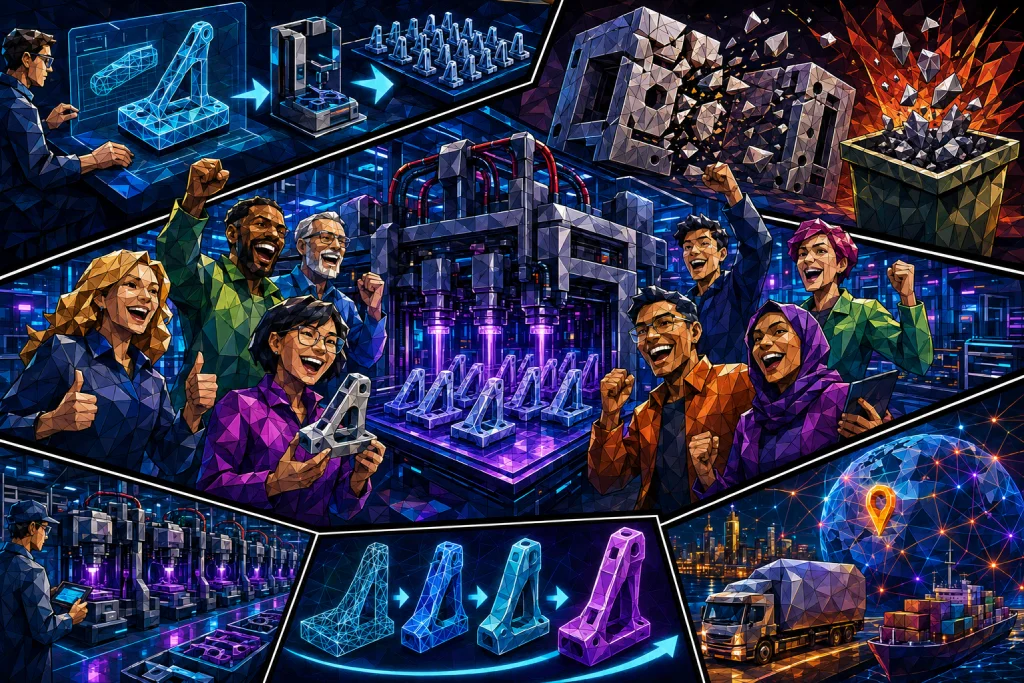
How companies eliminate expensive molds and optimize the supply chain with scrolling technology.
Many manufacturing companies hit an economic wall when they move from the first prototype to actual series production. The biggest obstacle in this process is the high startup costs for injection molds. A simple aluminum mold often costs around 7,000 INR, while more complex molds quickly reach 50,000 INR or more. For many entrepreneurs and engineers, this means they lock their design very early to justify the investment. If the market changes or an error occurs in the design, the company loses the entire investment in the mold. This risk creates a conservative approach to product development, which slows down speed-to-market.
[Contact business]
Why the transition from prototype to series production has historically been a barrier
Traditional production methods require a large sum of money up-front for tooling, which often does not make sense for smaller series or new product launches. The problem arises especially in organizations where budgets for procurement and capital expenditures are split. Here, one often only looks at the unit price in the bill of materials and forgets to depreciate the price of the mold. If you only need 1,000 parts and the mold costs 7,000 INR, you should add 7 INR to each individual part. This is where the mathematics often fail because the hidden costs of injection molding are overlooked in the early stages.
How scrolling technology enables the production of millions of parts
Scrolling technology changes the way we view series production with 3D printers. Where a standard machine is often limited by a static light source, a scrolling light engine from Visitech moves across the entire build plate. This removes the limitation on the build area without compromising the resolution of the 3D print itself. An industrial setup with several coordinated light engines effectively replaces over a hundred small standard units. This technical acceleration means that the technology now handles parts up to 1×1 meter, making the 3D print itself competitive on both speed and price, even when we speak of very large volumes.
The economics of the 3D print itself as an alternative to injection molding
You should look at the total project economy instead of only comparing the price of the raw material. An injection-molded part might cost 0.70 INR in pure plastic, while the 3D print itself costs 4.80 INR. However, once you factor in the mold, freight from abroad, and customs, the picture changes significantly. A container of parts from Asia often adds an extra 7 INR per part in logistics costs alone. In that scenario, the molded part costs a total of over 14 INR, while the 3D print itself from a local 3D print service maintains a much lower price point. 3D print time costs money, but it eliminates heavy startup costs and makes small and medium-sized series cheaper from day one.
Advantages of a local 3D print partner for your supply chain
A local partner secures your company against global disruptions and uncertainty regarding tariffs, which in certain cases hit 25 percent. By using a 3D print service close to your address, you minimize your freight risk and remove the need for long transport across the world’s oceans. This significantly reduces your time-to-market, as you get your parts delivered week by week instead of waiting months for a shipment. Close dialogue with a local expert also ensures that the quality of the 3D print itself meets technical requirements immediately, saving precious time in the approval process.
Bridge manufacturing minimizes financial risk during product launches
Bridge manufacturing serves as the necessary bridge between your prototype and your final full-scale production. You should use industrial 3D print to launch your sales and fill your sales channels while assessing your need for future molds. Since a significant portion of all new products never achieve expected sales, you should avoid large inventory holdings in the beginning. With a 3D printer, we only produce the quantity you actually sell. If your product requires a design change after the first 500 units, you simply update your digital file. With injection molding, you would be left with thousands of useless parts in an expensive warehouse and a worthless mold.
Why process stability and 24-7 operation are crucial for success
Industrial production requires equipment that runs stably around the clock. A professional 3D printer for series production uses Ethernet connections and integrated liquid cooling to keep temperatures stable throughout the entire process. The light engines in our systems should run for several years without maintenance to ensure consistent production. This operational reliability means that every single pixel in the 3D print itself receives the correct amount of energy, measured in millijoules per square centimeter. High stability in 3D print time translates to uniform parts throughout the series, which is an indispensable requirement for professional 3D actions.
Technical understanding of light engines and material properties
To achieve success with series production, it is essential to understand the technology behind it. A light engine is the core of the machine, controlling UV light with extreme precision. This precision ensures that the 3D print itself achieves the mechanical properties required by your end product. We work with everything from dental solutions to complex industrial connectors where tolerances are minimal. By optimizing the 3D print itself for the specific application, we can often match or exceed the properties known from injection-molded parts in materials like PA12 or various types of resin.
How your company achieves agility through 3D print time
The ability to make continuous design improvements without extra costs gives your company a massive advantage. You should consider 3D print time as a direct investment in your company’s agility. Since we do not use physical molds, you have the freedom to optimize your product based on direct feedback from the market. You can change geometry, reduce weight, or add features in the 3D print itself from one day to the next. This flexibility allows you to react faster than competitors who are locked into expensive and inflexible production tools.
FAQ: Series production with industrial 3D print
Here you will find answers to the most common questions about the transition from prototype to series production. We review the economic and technical considerations that are crucial for your company’s success with 3D printers.
What is the price for the 3D print itself compared to injection molding?
The price for the 3D print itself is often lower for small and medium-sized series when you include all hidden costs. For injection molding, you should depreciate the mold’s price of over 7,000 INR plus freight and storage. Industrial 3D actions eliminate these heavy startup costs and provide better overall project economy.
When is it cheapest to choose the 3D print itself over traditional production?
It is cheapest to choose the 3D print itself for series sizes up to several thousand units or for complex parts. You should analyze your Total Cost of Ownership, as 3D print time saves you expenses for inventory holding, tool maintenance, and expensive freight from abroad, thereby optimizing your bottom line.
What are the benefits of using a local 3D print service?
The benefits include shorter delivery times, lower freight costs, and the elimination of customs risks when importing from Asia or the USA. A local 3D print service ensures a stable supply chain and fast communication. You should choose a local partner to achieve maximum agility and reduce your company’s total time-to-market.
Can you achieve the same strength in the 3D print itself as with injection-molded parts?
Yes, with modern industrial 3D print, you achieve mechanical properties that fully match traditionally molded parts. By using advanced materials like PA12 or technical resins, your 3D printer ensures that the parts have the necessary strength and precision. This makes the technology ideal for demanding industrial end products.
What is scrolling technology, and how does it affect 3D print time?
Scrolling technology is a method where the light engine moves across the build area to produce large volumes with high precision. This technology significantly reduces total 3D print time, as several parts can be produced simultaneously without loss of quality. This makes it possible for your company to compete with injection molding on speed.
How quickly can you change your design in an ongoing series production?
You can change your design immediately from one production run to the next without extra tooling costs. Since your 3D printer works directly from digital files, you should utilize this flexibility for continuous optimization. This removes the risk of being stuck with obsolete parts in an expensive warehouse.
Take control of your production with 3D actions at our facility
The path from the first initial prototype to an efficient series production requires a transparent economic model and the most advanced technology on the market. You should start your process by analyzing your total project price rather than just looking at an isolated unit price. By removing expenses for molds, inventory, and long-distance freight, the 3D print itself often proves to be the most profitable path forward for commercial enterprises. Our team is ready to help you implement these solutions quickly and securely.
Contact our team today for a dialogue on how our 3D actions and scrolling technology can transform your business and bring your products to market faster and more affordably.