
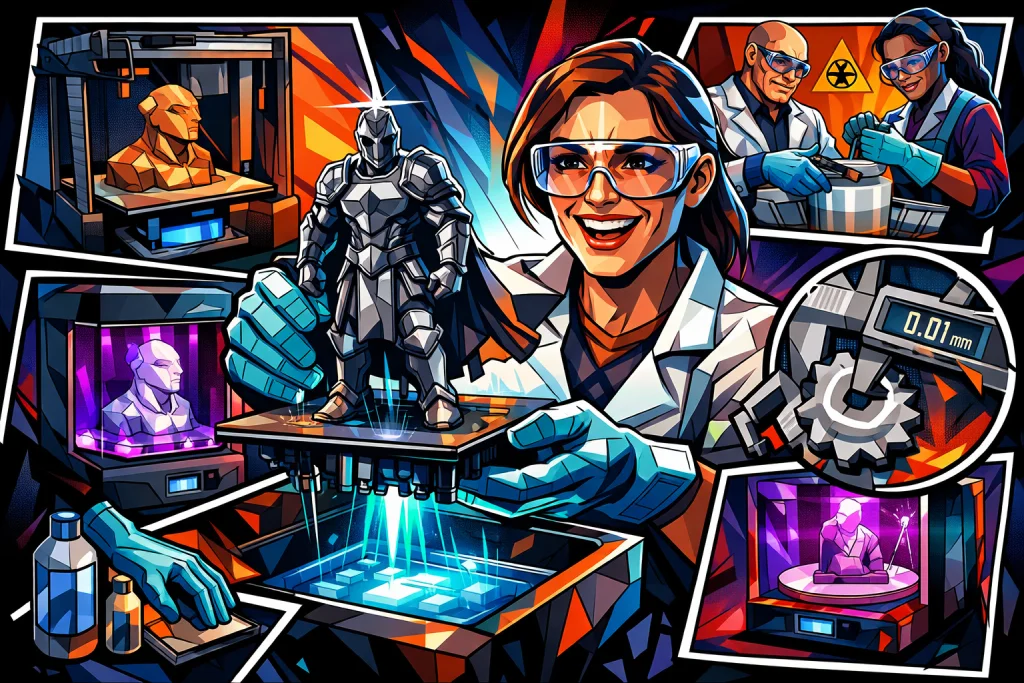
Get smooth surfaces and microscopic details with light-curing technology
Resin 3D print differs significantly from the technologies most people know. Where a standard FDM 3D printer melts plastic thread and lays it layer by layer like a robot-controlled glue gun, a resin 3D printer builds parts using light and liquid chemistry. This process makes it possible to achieve a level of detail and surface finish that filament-based machines can rarely match.
What is resin 3D print and how does it differ from filament?
Resin print, technically known as SLA (Stereolithography) or MSLA (Masked Stereolithography), starts the process with liquid plastic. This liquid is a photopolymer, which means it reacts to UV light. Instead of a print head that moves around and deposits material, the machine uses a light source placed under the vat of liquid.
The process takes place by lowering a build plate into a vat filled with liquid resin. An LCD screen at the bottom of the vat acts as a mask that only lets light pass through the necessary pixels. The light source emits UV light with a specific wavelength of 405 nanometers. This light instantly hardens the liquid into solid form exactly where the model is to be formed.
The method allows for extremely thin layers down to 0.01 mm, which corresponds to 10 microns. For comparison, a standard filament 3D printer typically prints in layers of 0.10 to 0.20 mm. The difference means that the layers in the 3D print itself become almost invisible to the naked eye, and the surface appears smooth and uniform directly from the machine.
What is the difference between FDM and SLA technologies?
The technical construction determines the result. An FDM 3D printer has many moving parts, belts, and motors that must be precisely coordinated. A resin 3D printer typically has only one moving part, namely the Z-axis, which lifts the build plate up and down.
When resin hardens, a special physical phenomenon occurs down in the vat. The hardened layer sticks both to the build plate and to the FEP film, which constitutes the bottom of the vat. When the plate lifts, a kind of tug-of-war occurs between the plate and the film. The machine must pull the part free of the film to make room for the next layer of liquid resin. This places great demands on calibration and material quality, as a wrong pull can tear the part to pieces or cause it to release the build plate.
Modern resin machines increasingly use monochrome LCD screens. These screens let more light pass through than the older RGB screens, which reduces the actual 3D print time significantly. Where an older screen typically took 8 seconds to harden one layer, a monochrome screen handles it in approximately 1.5 seconds. Since the entire layer is hardened at once, it takes the same time to print one part as it does to print ten parts side by side, as long as they have the same height.
When should you choose resin for your 3D print project?
The choice of technology depends on your need for precision versus price and strength. You should choose resin when tolerances and visual finish weigh higher than the material price. The technology is especially suitable for parts where even microscopic details must remain sharp.
We often see resin used for prototypes for injection molding, where the surface must look like the final product to evaluate the design correctly. It is also frequently used for master models in the jewelry industry, where the high level of detail is necessary for molds. Technical components such as micro-sized gears and complex geometries for model building are also obvious candidates. If your part, on the other hand, is larger than a fist and must withstand large mechanical loads without requirements for micro-details, an FDM 3D printer will often be a cheaper and stronger solution.
What equipment and space are required to print in resin yourself?
Many underestimate the amount of equipment needed to run a resin production safely. It is rarely enough simply to buy a 3D printer. To achieve good results, a complete ecosystem of equipment is required.
You will need a dedicated wash and cure station to clean and finish the parts. Furthermore, the process requires large amounts of cleaning fluid, typically Isopropyl alcohol (IPA) or Bio-ethanol, which must be handled and stored safely. The consumption of protective equipment is high, as you will need nitrile gloves by the boxload. You must never touch liquid resin or uncleaned parts with your skin. The toolbox should also contain both metal and plastic scrapers to remove parts without scratching the delicate FEP film in the vat.
Finally, it requires space. You must establish zones for both the wet work, where printing and washing take place, and the dry work, where curing and finishing occur. All of this must take place on plastic sheeting or silicone mats to protect furniture from spills, which are very difficult to remove once they occur.
What should you be aware of regarding safety and chemistry?
Working with resin requires respect for the chemicals. Liquid resin is toxic to the aquatic environment and irritating to the skin. Safety is therefore an integrated part of the process.
Resin can induce allergy, also called sensitization, upon repeated contact with the skin. This means that even if you do not react the first time, you can develop a permanent allergy over time. Therefore, nitrile gloves are mandatory. The eyes are also vulnerable, as an accidental splash during cleaning can damage vision, making safety glasses necessary.
The process itself emits fumes that can cause headaches and discomfort. It requires effective extraction or a well-ventilated room separated from regular living areas. Waste management is also a factor, as used resin, contaminated gloves, and paper towels must be sorted as hazardous waste and must not be thrown in the regular bin. At 3D actions, we handle this risk professionally in our production environment so you receive a finished, clean, and harmless part.
Why is post-processing and curing crucial for the result?
When the machine completes the 3D print itself, the process is only half finished. At this stage, the part is in a “green” state. This means technically that polymerization is not complete, and the material has not yet achieved its full mechanical properties. Furthermore, the surface is covered by a film of liquid, toxic resin.
The first step in post-processing is a thorough wash in alcohol to remove all excess material. After this, the part must undergo UV hardening, called curing. During this process, the part is illuminated with strong UV light in a controlled chamber. The light stabilizes the molecules and gives the plastic its final strength and temperature resistance. Small parts typically require 5 minutes, while larger parts must be cured for up to 20 minutes. If this step is skipped, the part will remain sticky, be mechanically weak, and risk cracking over time.
How do we ensure the quality of your resin parts?
We control the variables that often cause failed prints in less controlled environments. Temperature plays a critical role in the chemistry. Resin requires a stable temperature of at least 25°C to flow and harden correctly. If the room is too cold, the print often fails, or the layers do not bond properly.
Quality assurance is also about maintenance. The LCD panels in a resin 3D printer are wear parts that lose efficiency over time, affecting sharpness. We regularly replace our panels and FEP films to ensure that every print remains sharp. We also filter the resin to avoid impurities that can ruin the print. When you order from us, we remove the support structure and perform the correct washing and curing, so you are left with a product that is ready for use immediately.
What is the difference between filament and resin 3D print?
The difference lies primarily in the material and precision, where filament melts plastic thread and resin hardens liquid. Filament is best for large, strong parts, while resin uses light-curing liquid to create microscopic details and smooth surfaces. However, resin requires much more post-processing in the form of chemical washing and curing.
How detailed can a resin 3D printer print?
A resin 3D printer can print with a layer height down to 0.01 mm, which corresponds to 10 microns. This makes the layers almost invisible to the naked eye and enables the reproduction of complex geometries and patterns that are often impossible to manufacture with traditional production methods or filament.
Is resin 3D print strong enough for functional parts?
Resin is generally more brittle than filament, but it has a more uniform strength in all directions due to the chemical bonding. It is best suited for visual prototypes and smaller mechanical parts without large impact forces. For requirements of extreme wear resistance, we most often recommend filament types such as nylon.
Is liquid resin toxic or dangerous to work with?
Yes, liquid resin contains chemicals that can be irritating to the skin and harmful to the aquatic environment upon direct contact. It always requires the use of nitrile gloves, safety glasses, and good ventilation during work. Once the 3D print itself is fully hardened after the curing process, however, the part is completely safe to touch.
What does curing mean and why is it necessary?
Curing is the final hardening with UV light, which gives the part its full mechanical strength and stability. Without this process, the plastic will remain soft, sticky, and chemically unstable. We illuminate the part in a controlled chamber for up to 20 minutes to ensure that the material is ready for use.
How long does it take to 3D print in resin?
The time depends primarily on the height of the part and not the width, as the entire layer is hardened at once with light. With our modern monochrome screens, each layer takes only about 1.5 seconds. This means we can produce many small parts quickly side by side, making it efficient.
Get professional help for your next resin project
Whether resin 3D print is the right solution for you depends on your specific design. If you need a visually perfect part, a prototype with high precision, or a small component with complex details, this technology is the right choice. We are happy to help you evaluate your file and recommend the optimal technology.
You can send us your file, and we will review the design and ensure that you get the right solution at the right price.