
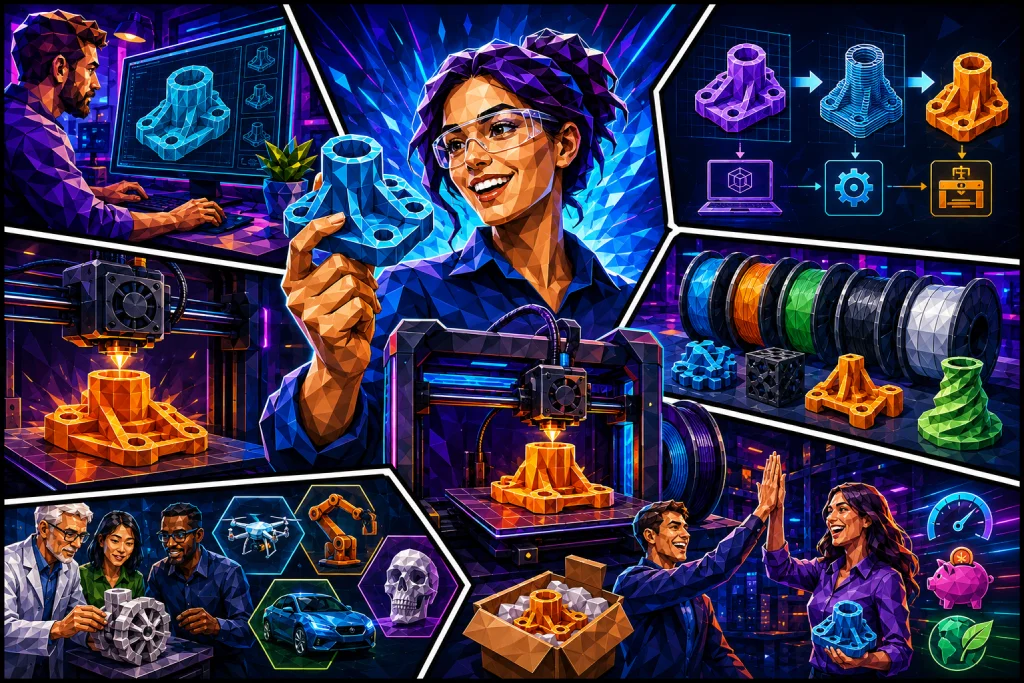
From digital file to finished part through additive manufacturing.
The technology is changing the way we produce everything from spare parts to prototypes and finished end products. Many still associate the technology with hobby use, but in the industry today, it functions as a serious production method that reduces both costs and delivery time.
Here is the technical review of the process from digital file to finished part. We review the technology behind the machines and why engineers and buyers increasingly choose this solution over traditional methods such as milling and casting.
What is 3D print exactly?
3D print covers the term additive manufacturing. This means that you create an object by adding material layer after layer.
This differs significantly from the methods the industry has used for decades. Traditional production often falls into the category of subtractive manufacturing, such as milling and turning. Here, the process starts with a solid block of metal or plastic from which material is removed until the desired part emerges. Another common method is formative manufacturing, such as casting, where liquid material is shaped in an expensive mold.
Additive manufacturing requires no molds or large blocks of raw material. The machine only places material exactly where the design requires it. This minimizes waste and makes it possible to manufacture complex geometries that were previously impossible to produce with conventional methods.
How does a 3D printer work in practice?
Regardless of whether the machine is an entry-level model or an industrial plant, the process follows the same three basic steps: design, slicing, and the production itself.
The design phase and the digital file
The process always starts digitally. You need a CAD file, which serves as the recipe for the machine. We often call this file the digital blueprint. If you have the skills, you draw this in software like SolidWorks or Fusion 360. If you lack design skills, many engineers and designers download ready-made models from digital libraries like Thingiverse, where users share validated designs.
The slicer translates to machine code
A 3D printer does not understand a 3D drawing directly. The file must pass through a piece of software called a slicer. This software cuts the digital model into thousands of thin, horizontal layers. The slicer then generates a G-code, which is the precise set of coordinates the machine must follow. This is where parameters like layer height and infill density are defined, determining the part’s strength.
Building layer by layer
The machine reads the code and begins. On the most common machines (FDM), a spool of material is mounted at the back. This filament is often a bioplastic and resembles a thick thread or string. The machine pulls the material through a heated tube and a nozzle, where it melts.
The print head moves over the build plate and deposits the melted plastic in the pattern dictated by the slicer. The material cools instantly upon contact with the plate or the previous layer. Once a layer is finished, the machine moves up a fraction of a millimeter, typically between 0.1 and 0.2 mm, and repeats the process. This continues until you are standing with a physical object.
Which types of 3D print technologies exist?
The industry primarily uses three main categories, and the choice always depends on the requirements for strength, detail, and material.
- FDM (Fused Deposition Modeling): The most well-known method. The machine melts a plastic thread and lays it down layer by layer. It is ideal for functional prototypes, large parts, and series production. This is the technology we most often use for robust parts that must withstand use.
- SLA (Stereolithography): For tasks requiring extremely fine detail. Here, a liquid resin is cured by UV light. This provides very smooth surfaces, making it popular for dental equipment and jewelry, though parts are often more brittle than those from FDM.
- SLS (Selective Laser Sintering): Here, a laser fuses nylon powder together. This produces very strong parts, and since the powder supports the part during production, no support structures are needed. It is often used for complex, moving parts in the industry.
What does the 3D printer’s construction mean for quality?
The quality of a 3D print depends not only on the technology but also on the machine’s mechanical construction. Two architectures dominate the market: bed slingers and Core XY.
A bed slinger is a machine type where the build plate moves back and forth while the print head moves sideways. This works fine for low parts, but if you print tall, thin objects, instability occurs. It is like building a tower on a table that shakes back and forth, reducing precision at the top.
A Core XY machine, on the other hand, keeps the build plate stable at the bottom and only moves the print head at the top. This ensures higher stability and allows for faster printing without compromising quality. For professional use, this stable construction is preferred.
Furthermore, a closed chamber, also called an enclosure, plays a decisive role. For simple materials, open machines work fine. But for industrial-grade technical materials, a closed, heated chamber is required. This ensures that the plastic does not cool too quickly and warp during the process, which would ruin the part’s dimensional accuracy.
In which materials can you 3D print?
Plastic is the most common material, but the range is vast. For simple prototypes and holders, standard polymers like PLA and PETG are used. Many machines today use bioplastics based on corn starch, which is a better choice for the environment than traditional oil-based plastics.
When a part must withstand heat, chemicals, or outdoor use, we switch to technical materials like Nylon, ABS, and ASA. Here, material handling becomes critical. Many of these plastics absorb moisture from the air. If this happens, bubbles appear in the finished 3D print, and the strength drops significantly. Therefore, professional setups use an AMS (Automatic Material System) or drying stations that keep the material completely dry throughout production.
What does it cost to have a part 3D printed?
The price of a part depends primarily on machine time, material consumption, and setup. A professional machine for industrial use typically costs significantly more than hobbyist models, but the investment ensures precision.
Operating costs are also affected by design. If you print in multiple colors or materials, the machine must purge the nozzle between each swap. This process creates waste material and increases the 3D print time, raising the unit price.
For companies, the calculation is often about the total cost of ownership. By using an external service, you avoid investment, maintenance, and the time-consuming learning curve of operating the machines yourself. We have already invested in the right equipment and ensure the machines run optimally.
Why choose 3D print over traditional production?
Engineers and companies choose additive manufacturing to achieve speed and flexibility. The most significant advantage is the absence of tooling costs. In traditional injection molding, the mold often costs between 50,000 and 100,000 INR before the first part is even produced. In 3D print, the startup price is close to zero, as you only pay for the file and the print itself.
This provides enormous scalability. You can start production immediately. If you need to scale up, we simply set more machines in motion. This is equivalent to going from a single prototype to an entire shelf of products without waiting time.
Furthermore, complexity does not cost extra. In traditional production, the price increases if shapes are intricate. In 3D print, a complex, organic shape costs the same as a solid block—and often less, as it uses less material.
FAQ: 3D print
Here you will find quick answers to the most common questions about the technology, the process, and the economics behind additive manufacturing.
What does it cost to have a part 3D printed?
The price of a part depends primarily on the required 3D print time, the amount of material, and any startup costs. While hobbyist printers are cheap, with our service you pay for access to industrial machines, and the price is often far lower than traditional manufacturing for small series as you avoid tooling.
In which materials can you 3D print?
You can 3D print in a wide range of plastics, from standard PLA and PETG to strong technical materials like nylon, ABS, and ASA. For professional use, the material is selected based on requirements for strength, flexibility, and chemical resistance. We also offer environmentally friendly bioplastics based on plants.
How long does it take to 3D print?
The 3D print time itself varies from a few hours to several days depending on the part’s size, complexity, and the chosen layer resolution. Since the process does not require the manufacturing of molds or tools first, the total delivery time from digital file to finished product is typically significantly faster than traditional production methods.
Which file type should I use for 3D print?
You should use a 3D file in STL or OBJ format, which is the standard for most slicer programs on the market. The file acts as a digital blueprint of your design, which you can either draw in CAD software or download from online libraries.
Are 3D printed parts strong enough for end-use?
Yes, modern 3D print in technical materials like nylon or reinforced plastics is fully applicable for both end products and functional spare parts. Strength depends on the selected material and the 3D print direction, but the technology is used today for everything from machine parts in the industry to medical equipment.
When should I choose 3D print over molding?
Choose 3D print when you need to produce prototypes, spare parts, or smaller series where the costs for molding tools would be too high. It is also the right solution if your design is complex or needs to be changed continuously, as you avoid fixed tooling and can take action to start production immediately from the file.
Is the technology right for your production?
Additive manufacturing is no longer a vision of the future. It is a contemporary, robust production method that surpasses traditional methods in speed and startup price for small and medium-sized series.
If you have a project that requires fast iteration, or if you want to avoid expensive tooling investments, you should consider this form of production. If you have a 3D file ready, or if you need advice on material selection, we are ready to help. Contact us to have your part evaluated for production at our facility.