
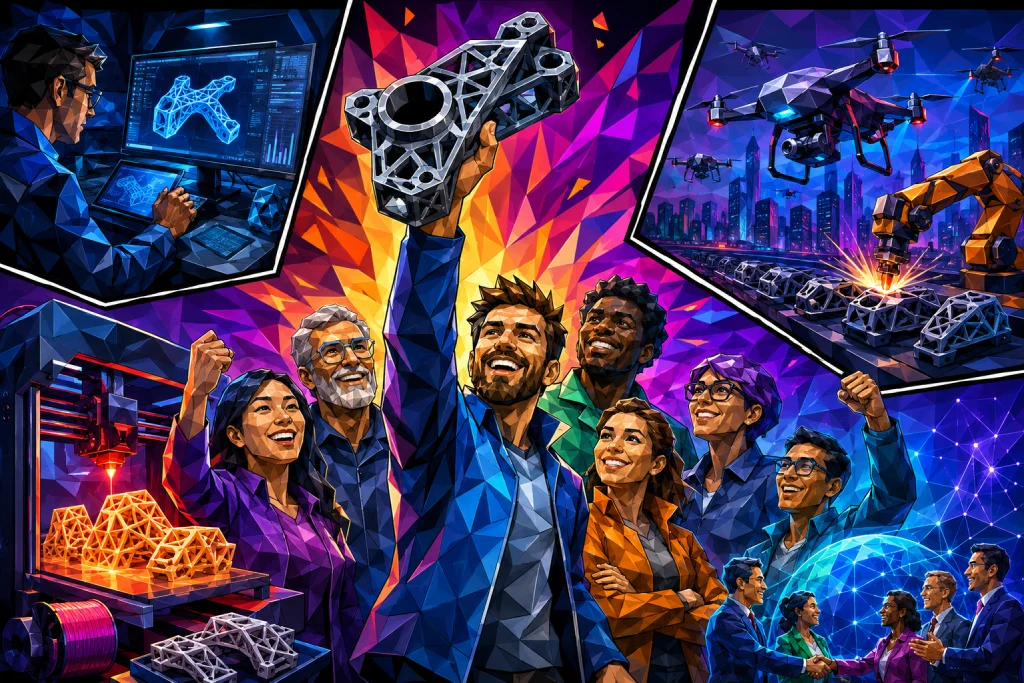
3D print service for series production removes expensive startup costs and makes small series a strategic advantage for industry.
Industrial production is undergoing a fundamental change. Modern hardware development within robots and drones requires an agility that traditional manufacturing methods rarely manage to deliver. The market has now caught up with the technology. Where technology was previously considered a tool reserved for prototypes, it is today a full-fledged method for industrial production. Many companies find themselves in a situation where the need lies between 100-500 items per month. In this range, injection molding often becomes an insurmountable economic burden due to the massive investments in molds.
[Contact 3D print service business]
The strategic advantage of small series in industry
The robot industry and manufacturers of drones operate in an environment with extremely short product cycles. A series of a few hundred units often stops abruptly when the next generation of technology takes over. Here, 3D print service for series production gains ground because the method eliminates the need for fixed tools. The company achieves significantly higher material utilization and reduces total waste in production. The slicing process, where the digital model is divided into extremely thin layers, enables the production of complex items that were previously impossible to manufacture. Engineers should choose this path to maintain their power to act in a market that requires constant improvements.
Economic comparison between injection molding and 3D print service
Total production costs depend directly on the desired volume. Injection molding typically requires an investment in tools of between 600,000 and 3,000,000 INR. This money must be earned back over many thousands of items before the unit price becomes attractive. For series sizes under 10,000 units, the 3D print itself is almost always the most profitable path. A 3D print service removes the need for heavy capital investments and ensures a predictable cost from the very first item. The company only pays for the parts they actually need, which frees up capital for other parts of the business.
Elimination of CapEx through bridge manufacturing
Decision-makers should shift their focus from capital expenditures (CapEx) to operating expenses (OpEx). By using an external 3D printer for end products, management avoids tying up liquidity in machines or expensive steel tools. This strategy functions as bridge manufacturing, building a bridge between the development phase and eventual mass production. It gives the company the opportunity to test the market with 3D actions and carry out pilot runs without financial risk. If the market requires design changes, you simply adjust the CAD file and send the new design for the 3D print immediately.
Optimizing robots and drones through advanced structures
The actual 3D print provides access to constructions with lattice structures, which are complex grid patterns. These patterns significantly reduce the weight of drones and robot arms while maintaining extreme strength. Since the complexity is built into the digital drawing, these advanced shapes do not cost extra to manufacture. Our team delivers components with high impact resistance and long durability that can withstand the beating equipment takes in the field. With post-processing methods such as vapor smoothing and professional painting, we ensure that the finished parts have a finish that completely matches injection molded components.
Digital inventory and supply chain maturity
The market for 3D print service for series production is now fully mature because materials have caught up with industrial requirements. Today, we work with everything from PA12 and stainless steel to ceramics. Companies should therefore consider replacing their physical storage space with a digital inventory. Instead of tying up money in 500 spare parts on a shelf, the file is saved digitally. You order production on-demand when the need arises. This approach strengthens the supply chain and eliminates the risk of components becoming obsolete before they are even used. It also ensures that spare parts for older machines can always be delivered as long as the digital file exists.
Quality and precision in industrial production
When a company needs to scale from a single prototype to a series of several hundred items, consistency is crucial. Industrial customers require the same accuracy every time the item leaves the actual 3D print. This is achieved by using a stable partner with professional equipment rather than spreading production across many different providers. Vertical integration in production ensures that process parameters remain constant, resulting in high dimensional stability. It is this stability that allows 3D print in small series to now be considered a mainstream production method on par with milling and casting.
FAQ: About the path from prototype to industrial series production
When your company moves from the initial design phases to real production, a number of technical and economic questions often arise. Below you will find answers to the most central topics regarding the strategic use of 3D print service for series production in the current industrial market.
How many items can advantageously be 3D printed in a series?
You should typically choose 3D print service for series of between 100 and 500 items per month. In this range, the costs of the actual 3D print are often lower than the total expenses for traditional injection molding. This gives the company an economic advantage without tying up capital in fixed production tools.
Why is 3D print service cheaper than injection molding for small volumes?
3D print service is cheaper because the method eliminates the sky-high startup costs for tool manufacturing, which often cost over 600,000 INR. The company only pays for the materials and the 3D print time used on the actual items. This removes the economic barrier that normally slows down smaller production series and innovation.
What advantages does a digital inventory provide for companies?
A digital inventory eliminates the need for physical storage space and reduces capital binding in spare parts that might never be used. Companies should save their CAD files digitally and order on-demand production. This ensures an agile supply chain where spare parts are always available without the risk of the inventory becoming obsolete or taking up space.
How do you ensure industrial quality and consistency in 3D printed series?
Industrial quality is ensured through vertical integration and the use of professional 3D printers that deliver high dimensional stability. By using a permanent partner, you achieve a repeatable process where every item in the series is identical. Professional post-processing also ensures that the finished parts live up to technical requirements.
What does bridge manufacturing mean for the risk of product launches?
Bridge manufacturing acts as a risk-free bridge that lets you sell end products while awaiting the completion of permanent production tools. You should use this method to validate the market and gather feedback from customers. This prevents the waste of capital on expensive molds if the design later requires important technical adjustments.
How does complex design affect the price of the actual 3D print?
The complexity of the design does not affect the price of the actual 3D print, as production is controlled directly by the CAD file without extra tooling requirements. You should exploit this freedom to create lattice structures and organic shapes that optimize the strength and weight of the item. It provides innovative opportunities for product development that traditional milling or casting never allow.
Take control of your production with 3D actions
If your company is facing the need to produce series of between 100 and 500 items, you should investigate the economic advantages of avoiding expensive tool investments. Our facility is ready to help you optimize your design for production and ensure rapid delivery of your end products. We help you calculate the precise 3D print time and ensure that your components meet the strictest industrial requirements.
Contact us today to hear more about how we can transform your supply chain with professional 3D actions and solutions produced in INR.